Having debuted with one of the best comedies of the last decade (Booksmart), Olivia Wilde returns with her third feature to claim yet another. The Invite is a hysterical chamber piece, an incisive character study and impeccable showcase for its cast, with a poignancy bubbling beneath which surfaces by the final act.
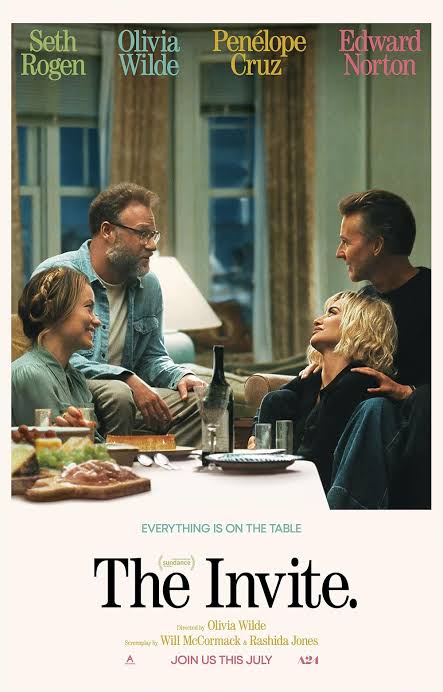
Based on the Spanish film, Sentimental, The Invite is set entirely (bar the opening credits montage) in the apartment of Angela (Wilde) and Joe (Seth Rogan), an unhappily married couple at each other’s’ throats in both passive aggressive and aggressive aggressive manners. Immediately argumentative as Angela flurries around preparing to host their upstairs neighbours for dinner despite Joe’s protests, the air is thick with tension when couple Piña (Penelope Cruz) and Hawk (Edward Norton) arrive. The smug sophistication and satisfaction of the opposite pair incites an unconcealed prickliness in Joe and unhidden admiration in Angela as sparring and sidestepping commences. As the evening draws on, the characters draw different things out of one another and cracks are highlighted to become chasms as dynamics shift and the upstairs couple’s intriguing lifestyle is revealed, spinning the night towards a new trajectory.
This is one of the funniest films in years, bursting with laugh out loud moments; the comedy ranges from subtle to heightened, throwaway moments to unignorable centrepieces. The dialogue is delicious and the line readings spectacular. There are perfectly executed moments of physical comedy and every blocking and editing choice is brilliantly conceived for maximum hilarity. It is sure to reward rewatches as moments will be missed due to the sound of laughter. The comedy works in tandem with the film’s biting commentary and character studies, all elements working together harmoniously to produce an overall experience with maximum impact. The comedy never supersedes the feeling of recognisable humanity in its characters, neither does the film get bogged down in its more serious moments or ever feel like the tone becomes fractured. The film barrels forward with an irresistible electric energy, buoyed by sharp, overlapping dialogue, committed performances and an anxiously frenetic orchestral score. The pacing and tone shift seamlessly across the unpredictable evening, moving forward with a momentum that stretches and contracts and a comedic tone that ebbs and flows, allowing for moments of pathos and genuine emotion that pay off beautifully in the final act. It is a truly smart adult comedy, the likes of which we are rarely treated to anymore, sophisticated but not remotely snobby and entirely capable of grounding itself in moments of emotion without sacrificing its utter hilarity.
A four-hander, The Invite is perfectly cast, with each of its actors on fine form, melting completely into their roles. The wild, eager anxiousness of Wilde and unhidden obstinance of Rogan against the coolness and initial mystery of Norton and Cruz creates a perfect sense of friction that erodes and evolves into a strange alchemy as walls are broken down and façades lightly challenged. Wilde’s strained and zany facial expressions are a comedic masterclass in and of themselves and she fully embodies the eager desperation of Angela, and the reluctance of her ties to her husband. Rogan delivers potentially a career-best performance, leaning into the deep dissatisfaction Joe has with his life, harnessing the dark defeat that comes from unrealised dreams and weaponising it as an apathy towards the expectations of polite company without losing its roots in vulnerability. Cruz is perfectly cool as Piña, a therapist entirely aware of her own effect on present company, whose calm observations seem to set her on a pane above Angela and Joe, unconfrontational but somewhat out of reach. Norton clearly relishes the smug zen focus of Hawk, leaning just towards the unbearable – so we somewhat empathise with Joe – but never becoming cartoonish. Layers are shed from all, showing cracks of vulnerability, to the detriment of some but benefit of others. The entire cast play off each other beautifully and the shifting tectonics of their relationships across the board feel organic and entirely convincing. A cast of this calibre also brilliantly sells the more moving moments of the film as it all builds to a touching catharsis that strips everything back to great effect.
The film’s origins as a play make sense in its one location, but Wilde makes this a distinctly cinematic experience, deploying all elements in the filmmaking arsenal to great effect. We are thrown straight into the zigzagging rhythms of the film through a brilliant opening credits sequence – the only shots outside of the apartment – where layered and changing split-screens beautifully set up Angela and Joe’s fractured relationship and the comedic tension that lays the foundation for what is to come. It is a visually intruiging opening that instantly pulls you in. Once we enter the apartment, thanks to the excellent set design, the apartment itself becomes a fifth character, with archways, windows and mirrors all utilised to great effect. The cinematography is full of clever choices, using these as frames to put physical barriers between characters as they confront their psychological ones, or using character placement to creative effect to add layers to the comedy. The score further underlines the comedy, tension and stresses of the characters and reinforces the rhythms and pacing of the film. The overall result is something that feels at once fresh and timeless, entirely engrossing as you feel in completely safe hands at every turn (even as you have no clue what wild turn the film will take next).
A true gem, it feels like a rediscovered classic in the vein of some of the great comedic chroniclers of the human condition; if justice prevails this will be cemented in the cannon. Hysterically funny yet touchingly human, this is an invite you really don’t want to turn down.


