Few films arrive with expectations as high as Christopher Nolan’s, let alone one which is an adaptation of one of the most ancient, epic and influential stories of all time. And yet, arriving after a wait that has felt almost as long as Odysseus’ journey home, The Odyssey somehow manages to surpass every hope to offer a truly astounding cinematic experience that feels blessed by the Gods that inhabit its story.
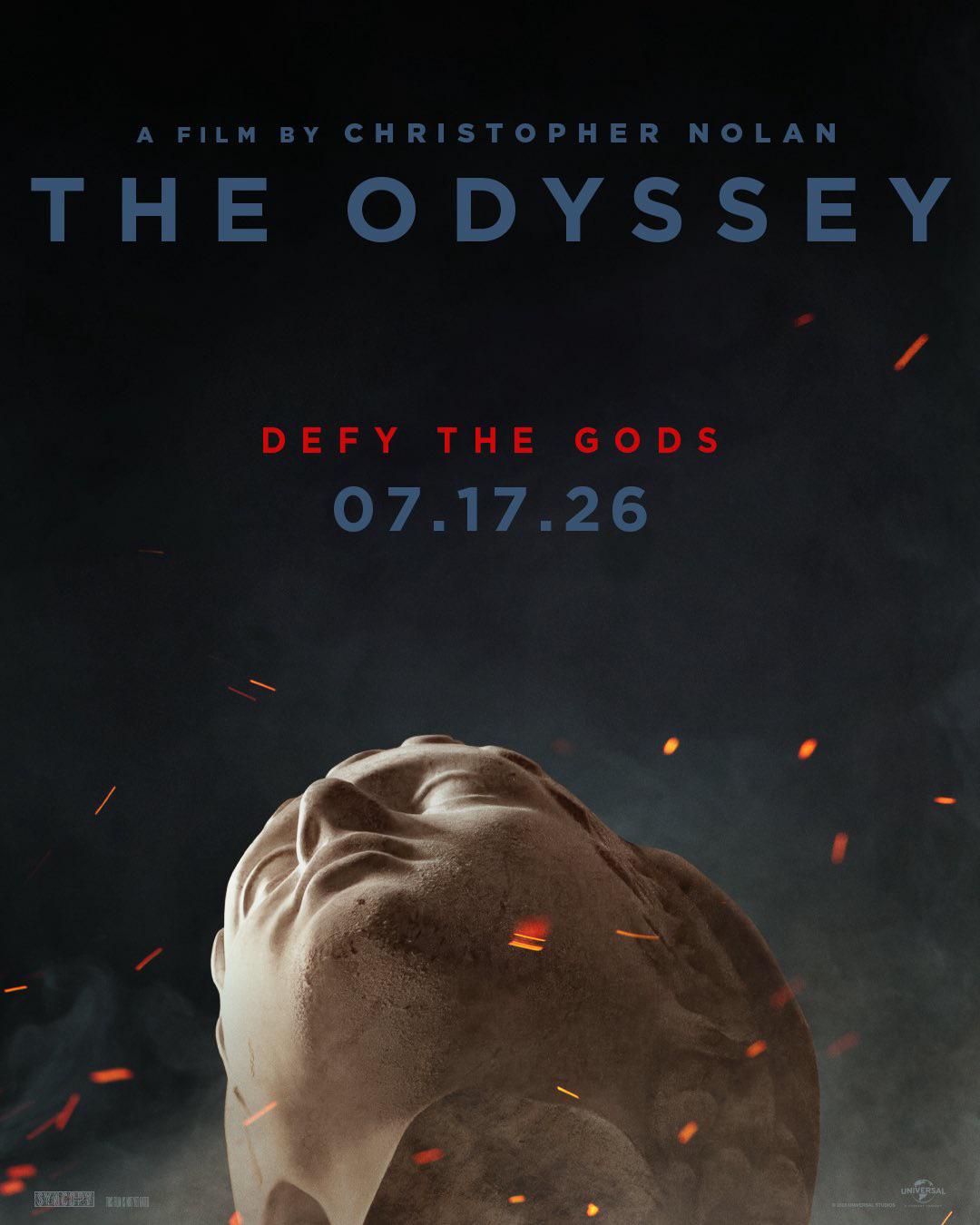
Based on Homer’s 3000-year-old epic poem, The Odyssey charts Odysseus’ (Matt Damon) ten-year journey home to Ithaca, following the decade-long Trojan war. Throughout a perilous journey, Odysseus and his men must contend with gods and monsters, striving against all odds and reason with drastic consequences. Throughout his crises, Odysseus converses with Athena (Zendaya), Goddess of wisdom and warfare, a figure of guidance and conscience. With no knowledge of whether he is even still alive, his wife Penelope (Anne Hathaway) waits at home, trying to fend off a scrupulous army of suitors, including the most pressing Antinuous (Robert Pattinson), determined to take Odysseus’ throne. Their son, Telemachus (Tom Holland), is steadfast in his stance that none of these men should take the crown, eventually setting out to search for Odysseus himself.
This is transcendent filmmaking. In the very best cinema, the screen ceases to exist and becomes merely a portal to another world; The Odyssey some goes beyond this – when consuming its story and spectacle, it is almost inconceivable that this is a film at all. Every element is executed near-flawlessly and brought together so harmoniously the stitches become invisible. The actors vanish into their roles, the production design and location work is so epic that we are totally transported to this ancient world and the focus on practical effects over CGI is deeply felt. For what must have been a herculean effort, the film never feels laboured. The Odyssey is incredibly grounded for such a fantastical tale, and it is an approach that pays immense dividends. This is unlike the other swords and sandals epics, never falling into the Hollywood conventions of an ancient setting (no posh English accents nor overly stilted, stately dialogue and camerawork here). Beyond the spectacle, it is a sense of reality that draws you in. Suspension of disbelief at the highest level.
The story unfolds in Homer’s nonlinear structure, obviously perfectly suited to a filmmaker like Nolan who rarely approaches his stories any other way. We shift around the timeline, falling into stories as part of a nested narrative, but the sequences never feel fractured. Jennifer Lame’s excellent editing keeps the film flowing beautifully, allowing the order of sequence to pay off beautifully whilst firmly keeping you along for the ride. The initial exposition builds steadily, laying the groundwork before we are swept off. Moments are held back until the emotional arc of the story and characters has built to its crescendo. The placement of the fully battle of Troy sequence in particular, whose context and messaging has echoes of Oppenheimer as Odysseus voices what haunts him. It is a feat of adaption to translate a 12,000-line poem into a film that retains that epic feeling without feeling rushed or as though there are holes in the story.
The cast is uniformly excellent, populating this world of magic with genuine humanity. Damon completely vanishes into the role, becoming the war-torn king, wrestling with his past actions, yearning for home, doubting gods and remaining a dutiful leader to his men throughout their lethal trials. And yet, despite his strengths, he remains mortal in fact and nature. Hathaway is a subtly fierce, steady hand at home, ripping off her regal pride in private and demurring to no one. Holland leans into Telemachus’ search for his place, his wavering belief in his father and increasingly headstrong clashes with his mother, a youthful contrast to the wearied, experienced elders. Pattinson is brilliant, relishing the role with a slight theatrical flair he steals focus and offers the perfect character to root against. John Leguizamo provides an unexpected heart to the film, fully embodying his character whose tenderness in his relationship to Odysseus is palpable. Elsewhere in the sprawling ensemble, Himesh Patel is terrific as Odysseus’ right-hand man, and Samantha Morton delivers a performance with a huge impression for such little screentime, her face full of wicked subtleties and flashes of the power within. Lupita Ny’ongo delivers a powerful dual role, another of little screentime but with a strong emotional impact and further implications to her story.
The cinematography is stunning, pulling you straight into the story. There are beautiful intimate moments between characters and shots that really bring home the scale of the story, in particular some breathtaking shots highlighting the isolation of Odysseus and his men on their long journey and emphasising the whirl of godly elements that they are at the mercy of. I have yet to see it in IMAX, but even at a regular cinema, the framing is beautiful and, had you no knowledge about the IMAX aspect ratio, you wouldn’t think twice about anything else. The sound design also matches the epic nature of the story oscillating between booming volume, the kind that reverberates in your heart, and quieter moments of contemplation. The entire film is also kept moving by Ludwig Goransson’s exquisite score, eschewing predictable cinematic tradition for authentic, ancient Greek sounds and an experimental flair.
The film reaches an unforgettable climax that will have you leaning forward in your seat and resisting an urge to punch the air, before the tension rachets back up. The emotional climax of the lead-up to this sequence, as well as its aftermath, is where Nolan lays his message bare and where such an epic story proves its eternal resonance as a depiction of civilisation, alongside the innate humanity of a survival journey. It leads to a final, thought-provoking frame where we finally see the reverse shot to one we have seen multiple times throughout the run time, as the film packs one final punch.
An epic of the ages, for the ages. This is monumental cinema that seems destined to be a classic (it somehow already feels like one). A breathtaking journey and singular cinematic experience, see it on the biggest screen you can.


Pingback: ‘The Odyssey’ and IMAX 70mm | REEL WREN