Into our increasingly isolated world comes this comedy about both literal isolation on a remote island and the isolation that can be felt even with people around you. Laugh-out-loud funny and subtly poignant in turn, The Incomer is a real treat that feels like a rare find in the current theatrical landscape.
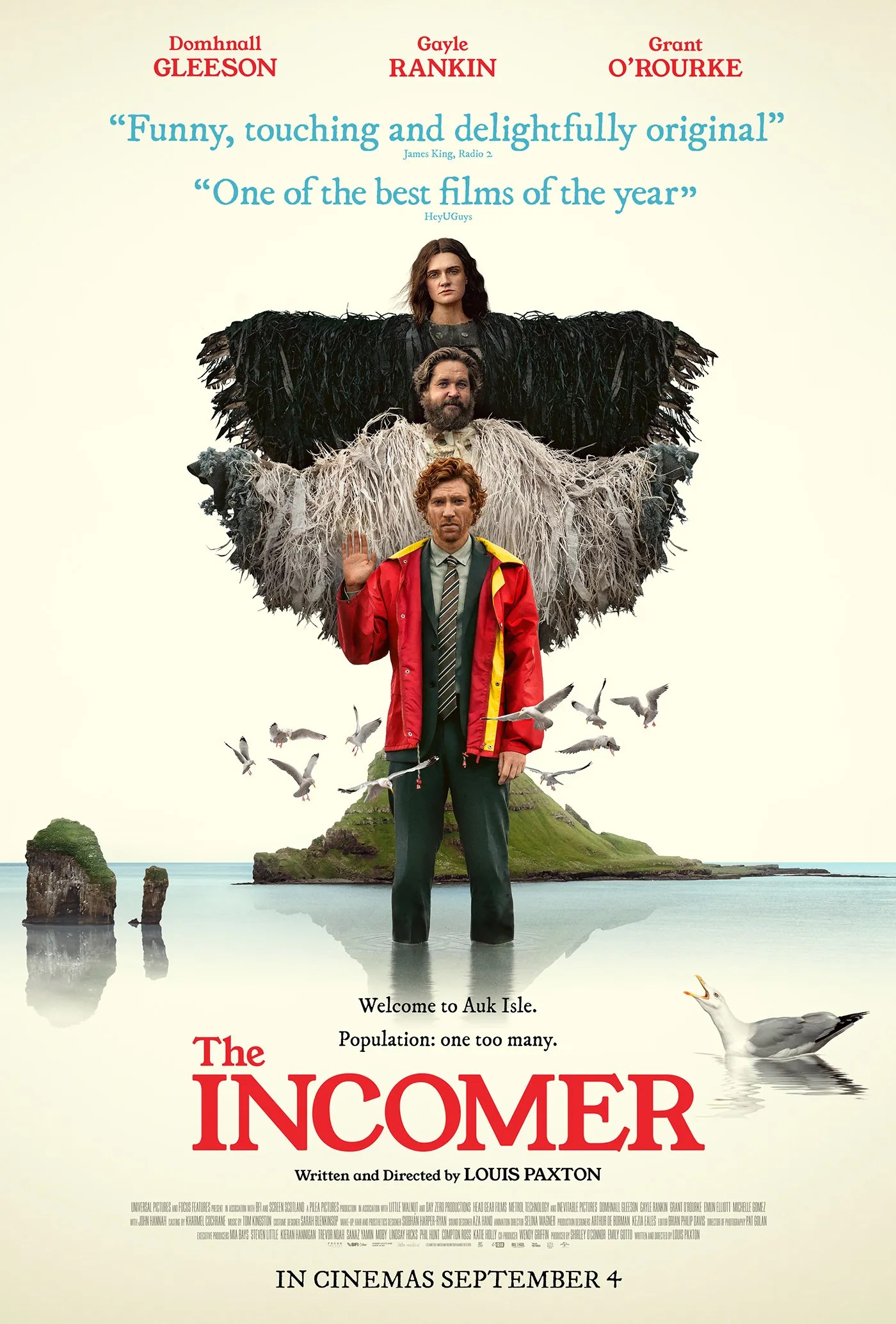
Two adult siblings, Isla (Gayle Rankin) and Sandy (Grant O’Rourke) survive alone on a remote Scottish island, with no contact with the outside world. They believe in the fantastical stories they tell of their ancestors, the folkloric elements of which appear present in their daily life; at least in the form of John Hannah’s Finman, a creature of the sea trying to lore Isla into its depths. They train to protect their land from incomers, believing any to be enemies. Cue the arrival of Domhnall Gleeson’s council worker, Daniel, sent to the island to inform the pair of their eviction. After some initial death threats in the name of defending their island, the pair slowly warm to Daniel and his tales of the mainland (and stories of Mordor that he definitely made up completely from his own imagination), slowly dismantling their beliefs of it as a place of evil, and particularly tempting Sandy with some of its charms, if not the far more sceptical and strong-willed Isla. The trio’s relationship begins to evolve as they each find something they’ve been missing. However, an earlier text for help send by Daniel before losing phone signal provokes a separate mission from the council to rescue him from the so-called savages, complicating matters further.
With brilliantly-conceived characters and writing that makes the most of its premise, The Incomer is genuinely hilarious, mining its concept and the culture clash of its characters for every ounce of comedy possible. It can take a minute to adjust to the film’s rhythm, but give yourself over to it and you are brought into its world. There are great moments of physical comedy and sharp dialogue of both the witty and cleverly silly variety. Sandy, as the slightly dimmer of the siblings, often gets the best lines, his childlike worldview ripe for laughs, and his contrast with the stony-faced Isla, often with an unsure, gentle Daniel caught in the middle, sets up some brilliant dynamics. The quirkiness is played into with fun costume design, namely the siblings’ form of armour, dressing up as gulls (and fully serious about it), and beautifully animated sequences of folklore as Isla recounts their family’s stories.
Director Louis Paxton keeps a good handle on the tone, with the film able to weave in moments of poignancy by building a genuine affection for its characters that ultimately earns the emotional payoff of its ending. Whilst undeniably a comedy, there are moments of light and shade across the film. Some of the humour is laced with darkness, where other scenes and stories are plainly quite dark, layered with pathos due to the characters’ lack of understanding of the stories they are telling. There are twists of the absurd and macabre, not least in the tales of the Finman and Hannah’s embodiment of him consistently trying to pull Isla towards her death’ his scenes are invariably bizarre and unsettling but increasingly sinister as the plot moves forward.
The trio at the centre of the film are uniformly excellent, the believable and evolving chemistry between them essential to the film’s success. They play off of each other brilliantly, landing pretty much every joke, and the unpredictability of their encounters, particularly at the beginning, creates a kind of comedic tension. Later, the sharper edges to Isla, naivety of Sandy and mildness to Daniel’s exterior are all peeled back by their actors, each displaying moments of vulnerability that in turn lead to laughs or moments of tenderness. The film explores themes of isolation from Isla and Daniel being alone on a remote island for decades to Daniel feeling alone even in a room full of people; the incomer and the islanders somehow recognise a kindred spirit, each learning the value of the company of others and the world of desires and possibilities that being with others can open up. They are supported in smaller turns by Michelle Gomez as Daniel’s villainous boss and Emun Elliott as an unstable suspended colleague sent in after Daniel, a hilariously menacing presence who appears to have watched too much Bear Grylls.
As further members of the council encroach on the island – ostensibly to save Daniel, in reality for more self-serving motives – the cartoonishness creeps in a little more, but the film remains balanced enough that it doesn’t derail itself. As emotions begin to run high on the island and relationships change, the film goes in for an emotional climax that doesn’t quite land as emotionally as it wants to but leads to its final moments that resonate with real heart.
Decidedly offbeat, this is a heartwarming, quirky and unexpectedly hilarious tale that speaks to the consequences of isolation that feel all too relevant in modern society.


