Announced with all the hope that Ridley Scott, an adaptation of a bestseller and a cast of top actors (some old hands, some recently risen stars) could bring, The Dog Stars unfortunately lands with a resounding thud. A disjointed, disengaged misfire, it offers little more than a perplexingly empty couple of hours.
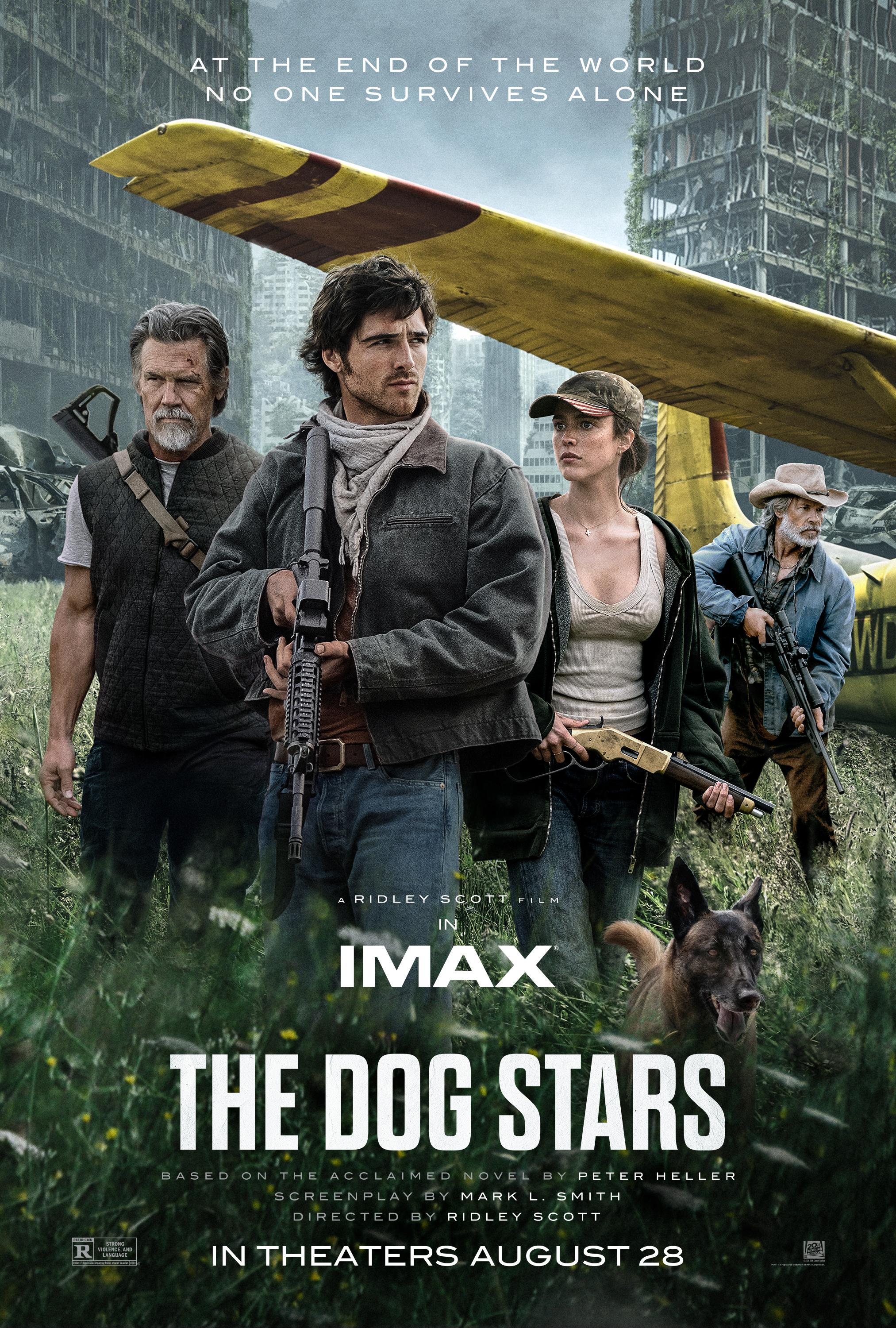
Set after a pandemic that appears to have wiped out the majority of the population and plunged the rest into a life of rugged survival, we enter the world of Hig (Jacob Elordi) and Bangley (Josh Brolin). The pair have carved out a steady enough life on an abandoned airfield, with Hig making regular runs (the titular dog in tow) into the local town, via a small plane, to find supplies and fly some over to a nearby Mennonite community. He also frequently makes stops back to his old house to remember his late wife. Despondent but not without a shred of hope, he frequently radios out, searching for a signal that someone is out there having had a brief blip of contact with a place called Grand Junction a year before. He soon decides to set out for the place by air, yet crashes en route, stumbling across the homestead of Cima (Margaret Qualley) and her father, Pops (Guy Pearce), an initially hostile encounter that evolves into something more before Hig plans to continue his mission.
This is a strangely airless film, completely lacking in atmosphere or energy with no propulsion or earned investment to keep you engaged. It begins with the impression of a slow burn post-apocalyptic plot, yet offers none of the character interiority or relationship development necessary to fill out the quiet stretches. We learn very little about who Hig or Bangley are beyond a projected, well-trodden character stereotypes – Hig the grieving widower with more faith in humanity vs Bangley, the hardened older man, content in isolation who sees others as a threat. Their conversations feel stilted and unnatural as if these are not characters but merely stand ins for overly done and very basic ideological friction. The dialogue does not flow and the relationship between the pair so undefined it feels as though the actors were not in the room with one another. We never learn how they met or if they even knew each other in the before times, an absence of exposition that could serve as promoting mystery or the essential need to focus on surviving the now but instead just feels confused. Likewise, we are given very little to go on beyond there being some kind of flu pandemic that ultimately resulted in their present circumstances but, again, the absence of this knowledge feels empty rather than intriguing.
A short action sequence involving intruders brings this act of the film to a close, offering something to briefly hold your attention, yet, like many other moments of jeopardy in the film, feels strangely calm and worriless. Higs then decides to leave, ultimately crashing and meeting Cima and Pops. The gentle chemistry between Higs and Cima, also grieving the loss of her spouse, injects a soft sentimentality to the sequence but this is never explored beyond surface level, preventing any investment in a potential relationship or chance to examine the complexity of any emotion. Pearce brings a gruff lived-in quality to Pops, perhaps the most believable element of the film, but is given little to do. The film ambles on, feeling aimless in its approach, before a crazed group of survivors appear both at Pops’ homestead and Bangley’s air field. The psychotic hoards feel as though they are from another film (Mad Max, in particular), making The Dog Stars feel even more confused. The action with the trio is somewhat engaging but with Bangley, again, lacks a real feeling of stakes or tension.
The film lacks any kind of cohesion and rarely makes sense; without any character development there is nothing compelling here and it strains your attention. It feels as though it should have been more introspective – I can imagine the book spends a lot of time inside the protagonist’s head – but instead it rests on an empty plot. Its aesthetics feel overly familiar and, in an attempt to manipulate the audience’s emotions, it falls back on cliched ideas that don’t hold any water due to a lack of any knowledge of or investment in the characters (dead wife flashbacks, anyone?). Late in the film, when Alison Janney shows up (giving a fully committed performance that is one of the more memorable parts of the affair), The Dog Stars takes a sharp turn into a whole different (and more interesting) film for a moment. It becomes thick with tension and even if the sequence is not perfectly executed, and somewhat derivative, it is at least intriguing.
There are some sequences with more interest and a few ideas that would have been worth exploring briefly mentioned, but the film doesn’t know what it wants to say. It ultimately feels like the bare bones of a story with none of the meat; confused and uninteresting, it is an unfortunate misfire with little to showcase that we haven’t seen before.


