In the latest film involving the events at Dunkirk, Joe Wright’s drama chronicling Winston Churchill’s first few weeks as Prime Minister uses an elevated pace to craft a film that frequently grips, but sometimes falters.
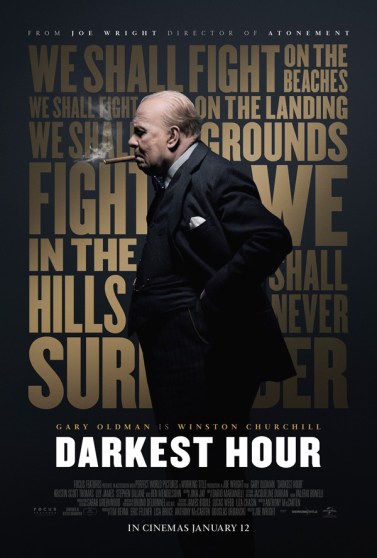 The film begins with the decision to select Churchill (Gary Oldman) as the new prime minister, following a vote of no confidence in Neville Chamberlain. We then follow Churchill right up until his famed ‘We shall fight on the beaches’ speech, with the film detailing cabinet disagreements, plots to get Churchill out of office, and the crucial decision of whether to attempt peace talks or continue with all-out combat.
The film keeps up a great pace, hurtling along in a motion that frequently qualifies it as more thriller than drama. Plus, as we have come to expect from Wright, the film borders on the theatrical at times, which serves to increase the dramatic tension. It is engaging and thoughtful, taking on events we know well, from the perspective of Churchill himself, which we have seldom been privy too. Perhaps the film’s ability to hold maintain huge amounts of tension (and bring it to boiling point) is damaged due to the great historical knowledge of the events that occur – we know the outcome, which detracts from the anticipation – and the fact that it is mere months since the release of Dunkirk, a visceral portrayal of the fight by the soldiers, sobering the perspective of the government bunker. We have even been treated to Wright’s envisionment of Dunkirk, with that famous tracking shot from Atonement, which means the tension in the war rooms is required to extend even further to overcome distractions of what is actually happening in France. However, it manages to present the stakes of the conversations it depicts, and crafts a rising tension from that successfully.
This is not a bland, all-applauding retelling, but a much more nuanced look at Churchill. It acknowledges his mistakes and misgivings, and takes the time to portray the inner life of the man, looking past the icon to give an insight that sets the film apart. It holds the rousing and inspirational moments you would expect (the final speech will likely elicit goosebumps, even if that is, in part, due to the fact that it is bolstered by the iconism), but is littered with quiet contemplation, ensuring that the humanity does not get lost in the story.
The film rests of Oldman’s towering performance. He is unrecognizable (thanks tot some stellar make-up and costume work), but doesn’t let the prosthetics do the transforming for him. He fully embodies Churchill physically, adopting his gait, mannerisms and ever little movement. What is more it is a performance that lives in the subtle moments. Oldman conveys incredible emotions through merely his eyes alone whilst having to maintain a more stoic expression; a masterclass in acting that is deserved of all the praise it is getting. He is supported by a fantastic Kristen Scott-Thomas and Lily James, who perhaps could have been given more to do, but then again, this is Churchill’s film.
Alongside Wright’s assured direction, each element of the film comes together to elevate the drama. Dario Marianelli’s terrific score helps propel the film along at its impressively engaging pace, creating a beat and rhythm that the film follows. The cinematography, from Bruno Delbonnel, is also astonishing, featuring frames that will be etched into your brain, and ensuring this to be one of the most gorgeous films of the recent releases.
This is an accomplished retelling of a well-known part of history, providing an engaging and gripping look at not only the events, but the man at the centre of them. Perhaps its short time-span may prove an issue for some, as well as its tendency to over-explain its historical references, there is no doubt that Oldman’s brilliant performance, housed in this well-crafted film, make this an entertaining and educational night at the movies.


Pingback: Oscar Nominations 2018: Initial Thoughts | REEL WREN
Pingback: Oscars 2018: Predictions and Opinions | REEL WREN
Pingback: Oscar Noms: A Triumph of the Non-Traditional | REEL WREN