Spielberg. Hanks. Streep. A story about freedom of the press and women in the workplace. This is a film with high expectations, and high expectations that needed to be met. Thankfully (and predictably), The Post delivers in spades.
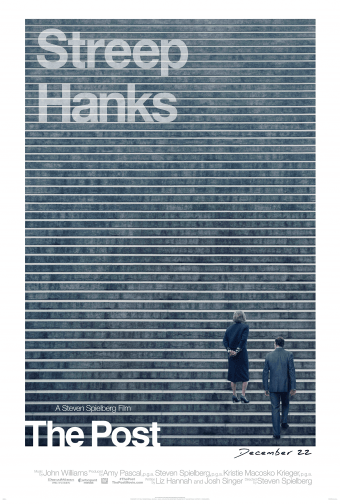 The film details The Washington Post’s involvement in the leaking of the ‘Pentagon Papers’ in 1971. The papers themselves were comprised of a secret government study into the United States’ involvement in the Vietnam War, a study which essentially concluded that there was no way for the US to win, but to essentially save face and avoid the humiliation of an American defeat, a string of four administrations continued to send soldiers out there to die. State Dept. military analyst, Daniel Ellsberg (Matthew Rhys), who had previously accompanied Secretary of Defense, Robert McNamara (Bruce Greenwood) out to Vietnam in 1965, and saw the lack of progress, decides to painstakingly, secretly photocopy all of the classified reports, and leaks them to The New York Times. Having had months to comb through them, The Times begins reporting various stories from the 47-volume study, but after days, are served with an injunction by the government and taken to court. It is then that some of the papers land on the desk of The Post, and a race begins to publish as quickly as possible, but that race is quickly disrupted by the reveal and realisation that doing so could result in jail time for many at the paper, most definitely executive editor, Ben Bradlee (Tom Hanks), and owner and publish, Katherine Graham (Meryl Streep).
In the wrong hands, with the wrong script, this inherently exciting story could have been boiled down to a dry, disinteresting account of purely legislation and practicalities. Here, it is a gripping, compelling, thrilling piece of cinema that pulsates with a sense of urgency guaranteed to enthrall its audience. The stakes are high, and are pulled to the forefront, as are the questions of morality and duty, freedom and doing the right thing, government cover-ups and the public’s right to know. The film also isn’t naïve enough to treat itself as a closed-off tale, it feels aware of the bigger picture and the real importance of what is at stake. It also places itself in the context of history and alludes to how the essence of the events portrayed in the film is repeated in numerous scandals across history (especially in its final scenes). It is also painfully relevant to today in the era of ‘fake news’ and (ridiculously stupid) attempts to discredit the press in the US, as well as the very timely portrayal of women in the workplace. What makes the film so great as well as its storytelling is that it doesn’t narrow its focus to one string of events, but looks deeper and comments on the environment surrounding the story as well. This is just as much about a woman in a man’s world as it is about exposing government lies, and it is all the more stronger for it. There is also a beautiful moment later in the film where she is leaving somewhere by the outskirts of the crowds gathered outside, and is walking amongst all of the women who have been relegated to the edges.
The film also chronicles Graham, the first female newspaper publisher in America, as she finds her voice and takes the stance she deserves in a world where she is the only woman in the room and is constantly spoken over, spoken for, or spoken about as if she isn’t standing right there. She is left walking behind the men as they discuss the business she owns, who make clear their lack of faith in her ability due to her gender. Graham inherited the paper after her father had left it to her husband who then tragically committed suicide. She carries a sense of feeling undeserving, even speaking about how when her father left the paper to her husband and not her, it felt entirely natural. It is only as the film progresses and the question to publish the papers becomes a real one rather than theoretical, she begins to find her grounding and her faith in her own abilities. The men who would once not let her get a word in edgeways now hold their breath waiting for her command. She is an intelligent woman with a lot at stake. To complicate matters further for her, a mere week before the climax surrounding the papers, she had officially signed a deal to take her paper public at the stock exchange (a decisions she has considered qualms over), and any ‘catastrophe’ (the likes of which would very much arise in publishing papers against the government’s will) would result in the bankers pulling out (a matter pushed primarily by Bradley Whitford’s board member, Arthur Parsons). Initially she is at loggerheads with Bradlee, who unabashedly believes they need to publish and is willing to go to jail for it, but she takes longer to consider, taking control in what becomes chaos, and asserting her authority.
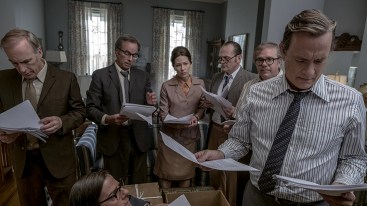 These clashes and conversations between the acting giants that are Streep and Hanks are as incredible as you might have wished. Filling these two central roles, the two are incredible. It is a true testament to their talent and skill that they always overcome the iconic statuses they have to contend with to still sink into roles and become unrecognizable. The challenge is heightened in a film brimming with icons of modern film (Spielberg, Streep, Hanks, Williams…) but they never the less become their characters and imbue them with such inner life. Streep brilliantly conveys Graham’s frustrations at her situation and desires to overcome the sexist barrier placed upon her, and gloriously delivers the growth that leads to her finally becoming who she wants to and is meant to be. In a perfect match, Hanks ensures Bradlee does not become a man of pure bravado, delivering a nuanced performance that hints at the worry behind his eyes, and the understanding of the consequences. In the scenes they share, their chameleonic nature is so accomplished you are never thinking ‘look its Streep and Hanks together’; you only see Graham and Bradlee.
The rest of the terrific ensemble is filled out by a host of familiar faces blended perfectly with some unknowns. This world feels bustling and real, and each character feels as though they are living beyond the scenes we see on screen. This is testament not only to the actors, but the terrific script by Liz Hannah and Josh Singer. Their screenplay ensures a story that is propelled along at a brilliant pace, but never feels overtly ‘Hollywood’ or as though things are being forced in at the right moments to keep the film afloat. It almost all feels organic and the film always engages, there are no lulls. It is also rare to find a film purely about professional relationships, without a forced romance thrown in, and it adds great credibility and a feeling of authenticity to the film for it.
Other standout elements come from frequent Spielberg collaborators Janusz Kamiński and John Williams. The cinematography is exquisite. The shots are often uniquely framed and there is a glorious mix of long takes, panning around the room whilst the characters switch place in frame, and shaky handheld shots which add to the urgency already pulsating from the screen. Williams’ score serves as an intermittent backdrop that helps to push the film on and give it its thriller-like feel. It is also used sparingly, which increases its effectiveness.
This is a phenomenal piece of work, a masterpiece of storytelling, and a story that is so important today. Never mind the miracle that Spielberg only first read the script in March of last year, and the film was finished less than nine months later, this is a thrilling and rousing piece of work whose events are sadly still so relevant over four decades later.


Pingback: Oscar Nominations 2018: Initial Thoughts | REEL WREN
Pingback: Oscar Noms: A Triumph of the Non-Traditional | REEL WREN