James Cameron whisks us back to Pandora for a third outing, following directly on from The Way of Water. Whilst it remains an immersive epic, Fire and Ash feels more familiar than it should.
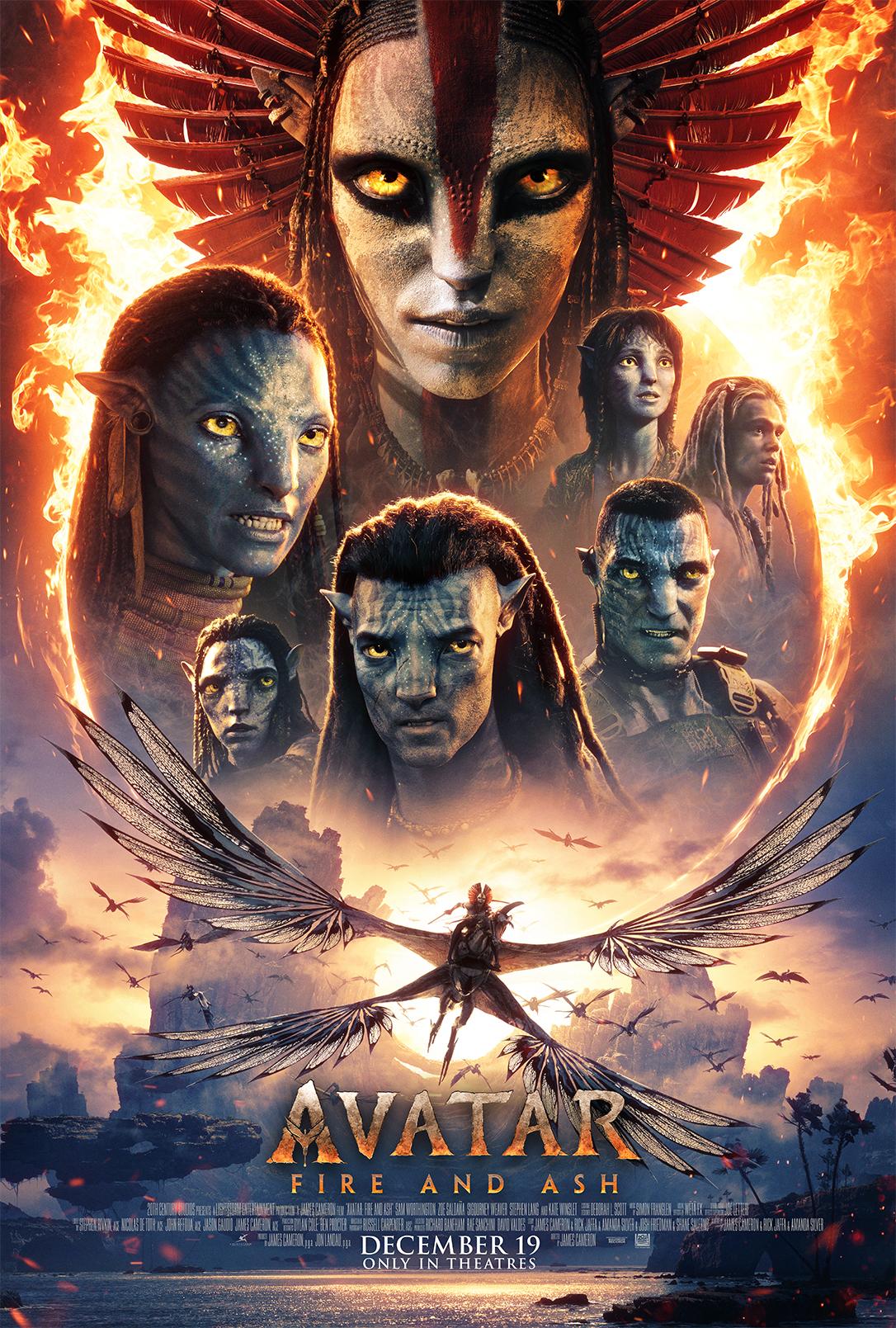
We rejoin Jake Sully (Sam Worthington), Neytiri (Zoe Saldaña) and their family as they are struggling with the grief of losing son Neteyam. Neytiri in particular now harbours an intense hatred towards humans, further complicating her relationship with Spider (Jack Champion). After Spider’s oxygen mask nearly fails, it is decided that, for his safety, the safety of the Metkayina tribe (Quaritch is still after Spider) and to ameliorate Neytiri, he should return to live with the human scientists still camped on Pandora. The family set out to take him there but are ambushed by the violent Mangkwan clan, the ‘Ash People’, led by Varang (Oona Chaplin) who live in a volcano and reject Eywa. The family become separated and soon Quaritch has recruited the Mangkwan in his eternal mission to take back Spider and kill Jake Sully.
Avatar remains an experiential ride. They are the only modern films that really warrant 3D and the pure immersion is unmatched; it is a joy to return to Pandora, wander amongst its plant life and ride its incredible creatures. It remains a true epic and the pacing is such that you do not feel its extensive runtime. The introduction of the ‘Ash People’ gives us a new landscape and tribal culture to discover, and a Na’vi clan much less friendly than those we’ve seen before; no longer are humans the only villains in the story. Varang is a magnetic and fascinating character who commands the screen from the moment she appears. Ooma Chaplin gives a fantastic performance and is likely the most memorable addition to the ensemble since the first film. However, she ultimately feels a little underused; the character arrives bursting with potential that isn’t fully met. Her and her tribe are moved to the side too soon; it feels as though they could have proven more interesting foils and opened up a new side of the Avatar world. Who knows, that may come later in the series. Cameron may be commended for not following a formula of setting the first film with the ‘air’ tribe, second with the ‘water’ and third with the ‘fire’ (but then, when has Cameron been bound by convention), but what we do learn about this new tribe makes you want to know more.
All of the actors remain great (if some are underused in an increasingly sprawling ensemble), with Saldaña in particular, as usual, delivering the most powerful performance. They all deserve more recognition than they get for their motion capture performances and the way they keep the audience invested. The grief shows new layers to the familiar faces and the subsequent complication of their relationship with Spider prompts new moral dilemmas allowing for some character development. Spider moves further to the forefront in Fire and Ash; much of the plot rests on him, so how you feel about him and Champion’s performance (and his exclamations of ‘sick’ and ‘dude’) will greatly colour your view of the film. He still feels out of place (and because he’s a human) in the bizarre dialogue choices and language he uses that it often just pulls you out of the film and makes the emotional scenes less impactful.
The bizarre thing about Fire and Ash is that it feels very much like The Way of Water story-wise. Cameron has said that this essentially started out as the second half of The Way of Water (before it ballooned too much to be one film), but even in that context it feels repetitive. As a standalone film, its predecessor aside, it often feels as though it is going round in circles and hitting the same story beats repeatedly. Even the final climax, whilst still a thrilling spectacle, feels just like what we witnessed last time. The first two films were very different in location, tribe, character dynamics and story so whilst there was a long gap between Avatar and The Way of Water that helped increase anticipation, I don’t think that was the reason for it working. Here, however, the shorter gap means that it doesn’t have the option of distance as a crutch to lean on. Who knows where the following sequels might take us but it sorely feels as though something fresh is needed and Quaritch’s never-ending vendetta is starting to turn stale.
Ultimately, this is a true spectacle that demands the big screen (and the 3D glasses), but is one that leaves you with a big feeling of déjà vu.
Bonus points when watching if you catch the (intentional or not) Aliens and Titanic references.


