Steven Soderbergh’s second film post-retirement could not be more different from his first. A filmmaker who has proven himself wildly versatile, he follows up last year’s quirky comedy, Logan Lucky, with a remarkably effective, and deeply disturbing psychological thriller. It revolves around questions of trust and feelings of paranoia which add up to a very involving, and unsurprisingly uncomfortable, viewing experience.
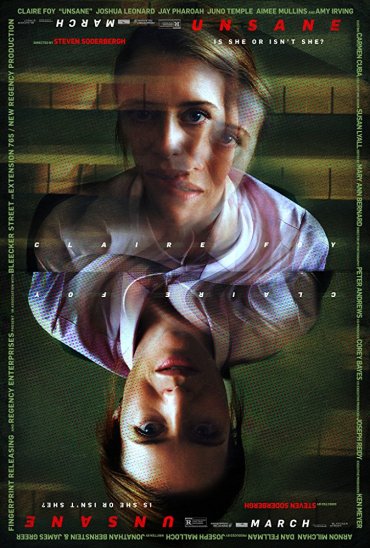 The film follows Sawyer Valentini (Claire Foy), a woman who has upended her life and moved across the country as a result of having a scarily persistent stalker. Dealing with seeing his face everywhere, she decides to attend a support session for victims of stalking at the Highland Creek institute, where, after signing what was presented as routine paperwork, she finds herself involuntarily committed, unable to leave. She begins to see her stalker there too, as well as comes to hear of an insurance scam that may be her reason for committal. As you can expect, not everything is as it seems.
The film packs in an impressive number of twists and turns, which don’t go in the direction you may predict. From the start we are questioning of Sawyer’s sanity; is she really being committed without medical reasoning, or is she actually suffering from psychological delusions? The film throws in enough clues for both arguments, as well as a hefty number of ambiguous events that keep you questioning everything you see, and keeps you engaged; no information is accepted as reliable leading you to constantly reevaluate your position. One of the film’s main strengths lies in the fact that whilst you are frequently unsure of Sawyer’s mental state, you are still on her side. The film’s subjective nature makes it incredibly involving, forcing you to feel as though you too are in the confines of the institution. The film inhabits its space, crafting a sense of paranoia and claustrophobia that plagues every scene, making its build up and climax so startlingly effective.
Perhaps what this film is most widely known for at the moment is the fact that it was shot on an iPhone. With Soderbergh at the helm, one can assume that this wasn’t a budgetary necessity, rather a creative choice – one of the first films to use a camera phone for such – a choice that adds a lot to what is occurring on screen. Firstly, in the right hands, using an iPhone does not mean an immediate reduction in the quality of the cinematography – the film doesn’t look like it just came off of your mate’s camera roll. DoP Peter Andrews (Soderbergh) exhibits some brilliant cinematography with an ingenious use of angles and perspectives that throw a lot onto the scene. The iPhone footage makes the film feel much more real, as though you are watching on spying on the events, something that adds to the unease throughout the film, especially within the context of stalking. Combined with the aspect ratio, it makes for claustrophobic viewing and plays into the disorientation of the whole matter. Perhaps this will herald in a less snooty approach to unconventional shooting devices.
From the marketing, you’ll go in expecting one film, but Unsane gradually begins to turn into another. This plays to the film’s advantage, performing a kind of bait and switch move that helps to keep the wool over your eyes a little longer, and keeps you engaged in the psychological questioning of the whole affair up until a pretty pointed reveal. From that point, the film shifts gears, ramping up the tension to unbearable levels by the time it reaches its climax. It gets increasingly more disturbing, eliciting audible gasps from the audience, and likely causing you to recoil into your seat. However, even when you get to grips with the turn the story has taken, the film leaves you hanging on to the edge of your seat, right up until the final frame – it doesn’t let you settle into any form of safe expectation. Its cleverness lies in you never being entirely sure of where the story is headed.
The entire film rests on the very capable shoulders of Claire Foy, who, up until this point, we have mostly seen in period dramas, and here, she is given a chance to break free from any restraint and deliver a powerhouse performance. She keeps you guessing about her character’s mental state, but not of her own state of mind, and manages to really get and retain the audience on her side throughout all of the twists and turns. She is supported by a strong ensemble that includes the likes of Juno Temple and Jay Pharoah, as well as a frequent Soderbergh collaborator who seems to be making a habit of secretly popping up in films. This is Foy’s film though, and she certainly owns it.
This is a brilliantly effective psychological thriller come horror film that will have you both on the edge of your seat, and burrowing yourself into the back of it. It keeps your brain engaged and involves its audiences to a heart-pounding and harrowing degree (you’ll need some time to recover), and hey, if the iPhone is good enough for Soderbergh, there’s no excuse for the rest of us.


