With the ever-circulating rumours of a Call Me by Your Name follow up, proposed to take place several years after the original to pick up with Elio and Oliver at a different stage in their life, I thought I’d take a look at one of the most successful (and few) film series with intentionally spread out instalments.
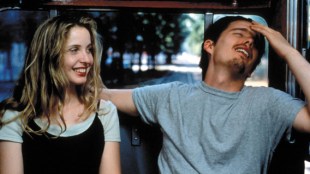
The Before Trilogy consists of three films – Before Sunrise (1995), Before Sunset (2004) and Before Midnight (2013) – all set, and made, nine years apart, that chronicle the relationship between Jesse (Ethan Hawke) and Celine (Julie Delpy), with each film set over only one night. It might be unsurprising to fans of another time-spanning cinematic experiment, Boyhood, that this saga was co-written and directed by Richard Linklater. What’s unusual is that both sequels were co-written by him and the two stars, Hawke and Delpy, helping to cultivate an increased sense of authenticity.
These films are each brilliant, and despite each centering on the same basic concept, each unique and interesting in their own way. Catching up with known characters at different points in their lives allows the film to explore new facets to their characters, and really show development. These spread apart films work for a number of reasons, and if Call Me by Your Name or any other story is going to try and emulate something similar, they too will need to accomplish these feats.
 One of the things that sets any film in the trilogy apart from other romances is the authenticity it carries, and the rounded characters it showcases which allow you to become entirely invested in them as people. With such a stripped back plot – literally two people walking around together for a night – the characters and their relationship are all the more important as everything rests on them. Through the honest conversations that the characters have, and the wide variety of topics those conversations cover, we come to learn a lot about them in a way that presents them as fully dimensional people with thoughts and opinions. The chemistry that blossoms between the two also adds to the sense of authenticity as it feels as though it evolves organically as they get to know each other, and we, the audience, do too. The way the film is shot also adds to this sense of realism in its use of long, steady takes, making it really feel as though we are privy to a snapshot of these people’s lives, rather than watching a constructed film. All of this helps to invest us in the characters and their story, allowing us to be hungry for more.
Another of the key things in telling a long-spanning saga is presenting a development in the characters and their relationship. If nine years have passed, things aren’t going to be the same and they shouldn’t feel as such. Especially in films such as these which take up a similar template each time, it is especially important not to merely repeat or try and recapture the exact tone of the previous film(s). A change in the characters’ dynamic is necessary in order to sell the fact that these are people who have been apart for nine years. They are not the same people, and they won’t pick up exactly where they left off; if the film did that it would undoubtedly ring untrue and cast a shadow of pandering to an audience’s likes. Character development not only helps to bring a sense of authenticity to the fact that these people have grown up, but also adds a sense of unpredictability to the proceedings. Things aren’t going to play out exactly like last time, thus piquing the audience’s interest and engaging them in what is going on. We, too, are also curious as to how these characters have changed.
 Finally, one of the most important aspects to get right in any sequel with a real-time gap is the recognition of that time which has passed. What the Before Trilogy does so well is it subtly and sporadically fills in the gaps between the films; as the characters catch up with one another, we are also catching up with them. The films craft a feeling that the characters have been living lives between the two films, just as we have, which also contributes to the feeling that they are real, and thus invests us further in their story. This differs to a film where perhaps the narrative flashes forward to actors in older makeup to tell the stories of them at different points in their lives. Here, we have been through the same amount of time as Jesse and Celine (in theory, even though you can now binge watch all of these films in a row if you wished), and thus to make it feel like it, the film has to indicate towards events that have occurred in that time (which also adds to the characters’ development).
The Before Trilogy is a masterful and epic tale of intimate romance which I would wholeheartedly reccommend to anyone who hasn’t seen it. It is the perfect (and probably best) example on how to successfully tell a story over a prolonged period of time, and with Call Me by Your Name’s foundation as strong as it is with the first film, the proposed series could craft another epic time-spanning saga for the cinematic ages.


