The latest from Paul Thomas Anderson is hard to categorise. Yes, it is a period piece, it is a romance, but it is also, in some sense, a comedy of psychological games that eventually pushes its characters to the verge of absurdity. It is an entrancing and intriguing piece, prepared to challenge its audience.
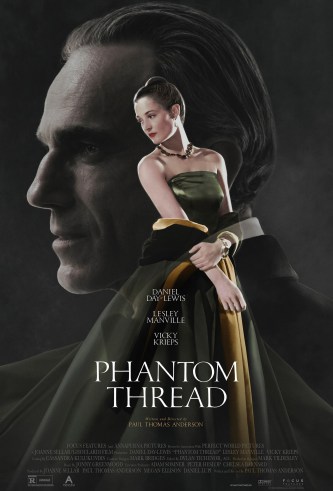 Set in the 1950s, Phantom Thread begins by following the admired dressmaker Reynolds Woodcock (Daniel Day-Lewis), who runs his business with his sister (Lesley Manville) and is one of the most sought after designers in London, dressing everyone right up to royalty. The self-proclaimed eternal bachelor soon meets Alma (Vicky Krieps), a young waitress upon whom he becomes transfixed and whom he invites to live with him in his London townhouse-come-studio. Soon, the artist’s meticulous and controlled life is thrown into a state of disarray as Alma and her love begin to encroach on the careful lifestyle.
What follows is a masterfully crafted yet curious film. It is strangely compelling as it builds a quiet suspense, rarely found in films centering on romance, which keeps you engaged and invested in the characters’ next moves. It is incredibly atmospheric, owed in large part to Johnny Greenwood’s beautiful score that lies over most scenes (although Anderson also uses silence expertly) and wraps it all together, and the gorgeous cinematography that frames sumptuous fabrics and sets. This atmosphere and suspense carries you along with the film, as well as presents a feeling of unpredictability, leaving you hanging on to find out what happens next.
The film may initially seem to be about the journey of the artist that Day-Lewis portrays, but it soon becomes Alma’s film. What begins as a romance becomes a tale of emotional games as a power struggle rises in the relationship, as the characters flit back and forth between feelings of love and loathing, which inform their actions and feed their unusual, undoubtedly unhealthy, yet ultimately intoxicating relationship. It becomes about the games people play, but is done in a very subtle, effective manner. These games provide surges of tension, as well as some of the more comical moments in the film, displaying the quietly tumultuous state of their feelings. It will leave you unsure of where they are going and how the plot will wind down, and it may even begin to lose some of its audience as the actions become more extreme. It is probably the least accessible of this year’s awards bunch, but is exquisitely rewarding for those who let it in. The film makes all the more sense if you are familiar with Anderson’s work, and remind yourself that this film shares its creator with the likes of Punch Drunk Love.
The performances are paramount in carrying this film, and, unsurprisingly given the caliber of those involved, they are stunning. Day-Lewis has delivered a worthy final performance, as chameleonic as ever in his portrayal of Woodcock in everything down to his peculiar speaking manner. We can only hope that his retirement won’t last, but if it does, he has certainly gone out on a high. In facing off against the acting giant, newcomer Krieps had a weighty task, but she manages to match him every step of the way. She more than holds her own as Alma, injecting humanity into the story, and delivering a remarkably layered performance. It is a shame she seems to have been overlooked in the accolades department. Manville rounds out the principal cast with a fantastic performance that takes what could have simply been a one-note stern-faced role, and crafts delicate subtleties in order to elevate her role.
This is an original film in Anderson’s distinct vein, enveloping its audience and leading them through a series of twists and turns to result in an exquisitely crafted, unusual, intimate and feverish tale.


Pingback: Oscar Nominations 2018: Initial Thoughts | REEL WREN
Pingback: Oscars 2018: Predictions and Opinions | REEL WREN
Pingback: The Oscars 2018 | REEL WREN