Following the gloriously electric A Bigger Splash from 2015, Luca Guadagnino’s intoxicating style returns to the screen with this adaptation of André Aciman’s novel, but in a much more restrained and melancholic manner, to produce one of the most authentic and touching romances of recent years.
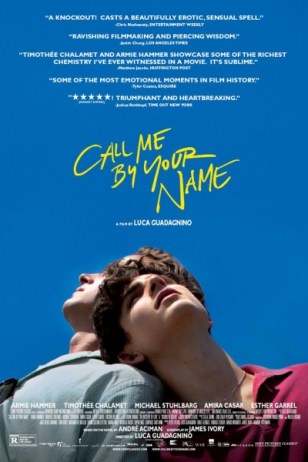 Set ‘somewhere in Northern Italy’ in 1983, the film focuses around the home of 17 year-old Elio (Timothée Chalamet) as he spends a summer riding bikes, swimming, and doing nothing. However, when American Oliver (Armie Hammer), a doctoral student, arrives to assist Elio’s professor father for the summer, Elio’s world is disrupted. Faced with new feelings of desire, he and Oliver attempt to navigate their attractions, whilst reconciling their feelings about this new awakening.
What follows is a tender yet sensual coming-of-age story where the romance threatens to spill of the screen as the film swells with longing. It is also a different approach to what mainstream audiences may be used to seeing as part of a gay romance. Opposition here does not come from external forces – perhaps a homophobic character, or an imposing society. Instead, in the embrace of a very liberal family, in a fairly reclusive setting, the opposition and conflict is embodied internally within the characters. Of course, external opposition is out there, but is so far removed from the world our characters inhabit for the summer, that its presence is only in a few words of dialogue expressing internalised societal judgements. The characters wrestle more with the newness of these feelings (not just of love for another man, for Elio, but of love in general), and a confusion about them. This is all done subtly though, as the passionate attraction seems to overpower any resistance which instead comes across as a meek rebuttal against something that isn’t really unwanted. The great tension built in the film instead comes almost entirely from the masterfully portrayed sense of longing.
It is a gorgeous film, both beautiful in its cinematography and design, but also in the genuine emotions it teases out, and its portrayal of passion on screen. Many scenes are filmed in long takes (there are few heavily cut scenes), allowing the characters to breathe and their fervent desire to ferment. It builds a stunning atmosphere that pulls you in and adds to the feverish moments but also allows for more relaxed scenes. The emotions are never overpowered by the sun soaked setting, but instead almost meld into it, in a way that makes each element feel connected (including the entrancing soundtrack which serves to enhance the atmosphere even further). The entire film carries a sense of the authentic, always feeling organic, never constructed or forced. It feels honest and truthful, nothing feels exploited or overdone for effect. It also doesn’t follow the conventional pathway of a romance, allowing a feeling of uncertainty to build up, in much the same way it does for the characters. It is also imbued with a sense of melancholy throughout, part of what makes the film so much more layered than a lesser adaptation could perhaps have been.
Of course, a film like this could not survive let alone thrive in the way it does without a powerhouse central performance. Chalamet delivers in spades. He fully embodies his role and manages to externalise the inner feelings of Elio in a way that flits beautifully between subtlety and openness at just the right moments. There is one scene in particular with just a close-up on his face, and you are entranced, unable to look away and instead absorb the emotions of this young boy. He really announces himself as an incredible actor here, and one who should certainly be watched for the future. However, even with an incredible Elio, the film would not work without his match in Oliver; luckily we are delivered both. Hammer has been able to prove himself more capable than we have seen in his previous roles, imbuing Oliver with much more depth and dimensionality to bring him to life as his own person, not merely the object of Elio’s affection. The chemistry that develops between the two is spectacular, and unmistakable when they are both on screen. The only issue some may find is the age difference between the two (Hammer is older than his character is intended to be) but for most this will be a non-issue.
The rest of the ensemble is also fleshed out brilliantly to create a buzzing world where no one is reduced to a one-note character in the name of plot propulsion. Michael Stuhlbarg and Amira Casar are familial and contemplative as Elio’s parents who are treated neither as an easy opposition, or ignorantly unaware of their son’s feelings. Esther Garrel is also fantastic as Elio’s brief girlfriend, who, despite us understanding the likely result of their relationship, manages to elicit great feeling and empathy. This film doesn’t forget about its smaller characters but makes sure they feel as though they are living even when off screen.
This is a powerful film that whilst focusing on a romance, is as much, if not more, a coming of age tale that packs a punch. It is not a shouty film, but is subtle and delicate, raw yet refined, and never dips into the melodramatic. Guadagnino’s masterful direction ensures that this is a film that pulses with passion, so much so that the longing even feels palpable at times. It is a poetic and sensual affair that is touching for so many reasons, and more layered than most movie romances. It earns each moment (including a spectacular fourth wall break), and will have earned your heart by its end.


Pingback: 2017: Progress in the Industry | REEL WREN
Pingback: Beyond 2017 | REEL WREN
Pingback: My Top 10 Films of 2017 | REEL WREN
Pingback: Oscar Nominations 2018: Initial Thoughts | REEL WREN
Pingback: Oscars 2018: Predictions and Opinions | REEL WREN
Pingback: The Oscars 2018 | REEL WREN
Pingback: DVDs of the Month: March | REEL WREN