Famed in his later years, this new slice-of-bio pic from Matt Johnson offers us a look into one foundational summer in a teenage Anthony Bourdain’s life, where, in hindsight, it seems as though something serendipitous was setting the table (sorry) for his future. Tony is a warm and enjoyable summer adventure and character portrait, even if it doesn’t quite come to life with all of the colours and textures that Bourdain’s own storytelling was known for.
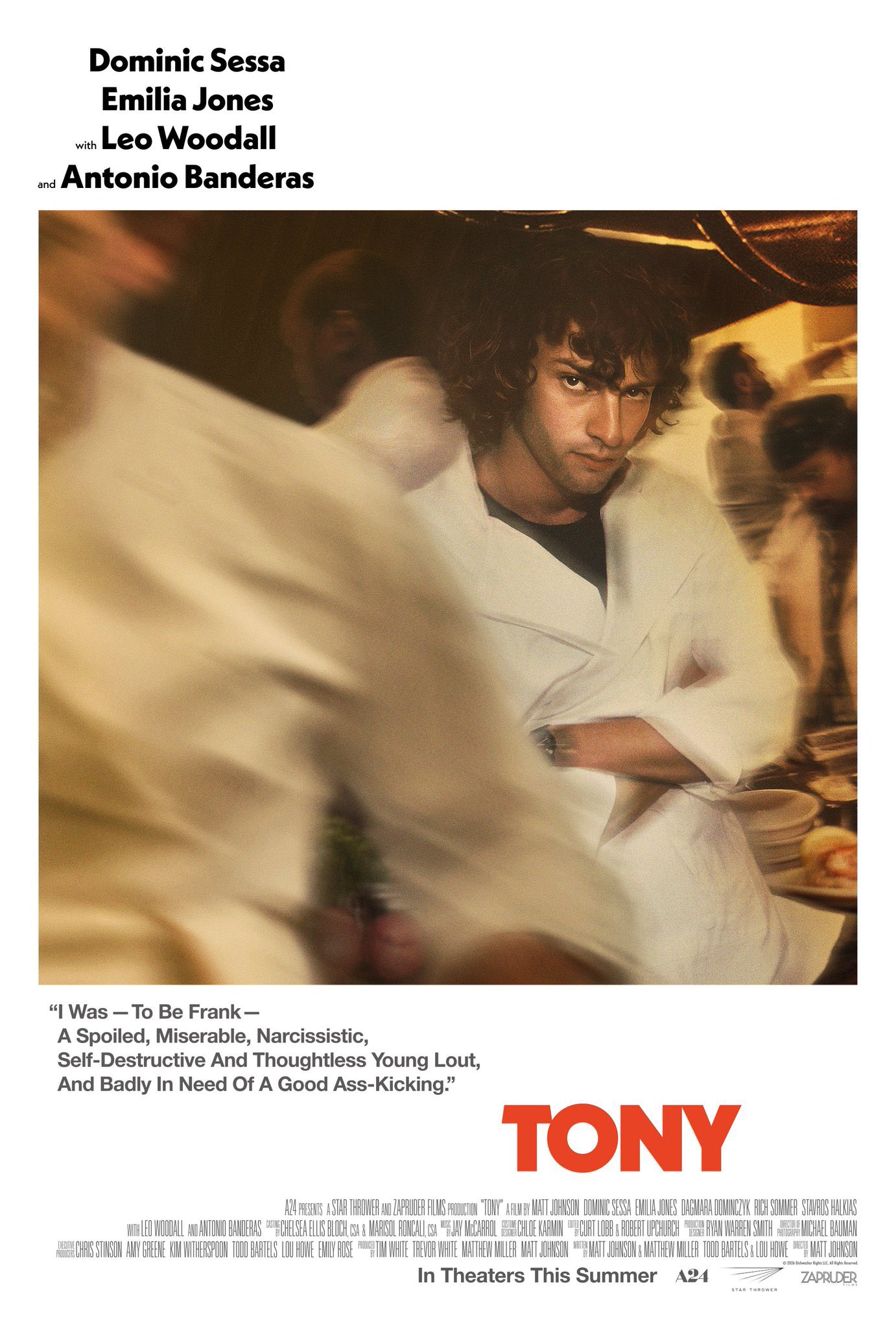
We meet Bourdain (Dominic Sessa) as a conceited 19-year-old college student with ardent dreams of becoming a writer. So strong-headed in his belief, he tells everyone around him he has received the summer’s writing fellowship from Vassar college prematurely, and keeps up his lie even after he finds out he didn’t win. Running away from home in the middle of the night, Bourdain makes it to Provincetown, following a girl, Nancy (Emilia Jones), but keeps up his alibi even with her. Thrown out of a bar one night, the mercy of its head chef (Antonio Banderas) lands Bourdain sleeping on a hammock on his porch, an arrangement the broke student pleads to keep up, in exchange washing dishes in his small, chaotic kitchen. Reluctant and ignorant at first, he is soon slowly ingratiated into that world and dragged down from his literary high horse.
For a man who was involved in documenting much of his own life, it feels wise that the film chooses to focus on one pivotal period, centring a lost teenager stumbling upon his future. The film sets itself apart from most modern biopics as, for the most part, it does genuinely seem more concerned with the man than the myth. We mostly see Tony as a confused kid, pompous but human and entirely unknowing of his own future as we all are, refreshing for a genre that often treats everything – success, stardom – as preordained. There are little moments and a few lines of dialogue that drip with dramatic irony, but they find their ways into scenes organically and the film never panders to its audience or winks at the crowd, helping it to maintain a sense of authenticity that is at the heart of Bourdain’s legacy. It opens with a quote from Kitchen Confidential that sets the tone – Bourdain didn’t sugarcoat his descriptions of his past self and the film isn’t too afraid to show his flawed character and behaviour.
At the centre, Sessa gives a strong performance, reminiscent of his breakout in The Holdovers. He shows a vulnerable depth beneath Tony’s hard exterior, playing out his development as messy and non-linear, keeping the film grounded. His hard edges are slowly softened by Banderas’ head chef, who injects an unfamiliar trust and belief into his underling, with Banderas bringing a quiet gravitas to his role, rounding the character out beyond his function in Tony’s story. Jones is suitably magnetic but given very little to work with beyond the stereotype parameters of ‘protagonist’s dream girl’. The kitchen is rounded out by colourful characters played with baked in assuredness by Stavros Halkias and Leo Woodall. Woodall’s hedonistic chef, in particular, becomes instrumental in Tony throwing himself into the wild life of a summer hang-about, but also the catalyst for the sobering moments that bring him back to himself.
The film feels like it could be about any young man, fictional in the best way. Johnson approaches this coming-of-age tale as a satisfying story in itself, leaving it at the perfect moment to set Tony, then Anthony, off for the rest of his life. It is an entirely enjoyable journey, if a little more conventional that you would expect from Johnson. It doesn’t quite cut as deep as you would hope and becomes a little hard to get inside, preventing it from having a more lasting impact.
An interesting and enjoyable telling of part of Bourdain’s life, made stronger for its genuine focus on the unknown teenager than preoccupation with the shadow of the famed man.


