After months of speculation and pre-film discourse, Emerald Fennell’s “Wuthering Heights” has arrived in cinemas and it is unfortunately everything that was feared and more.
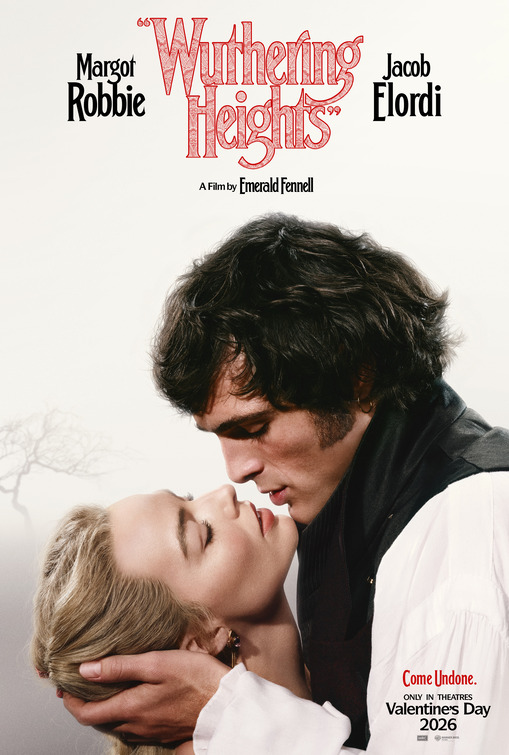
Ostensibly adapted from Emily Brontë’s classic novel, the film centres on Cathy Earnshaw (as an adult, Margot Robbie), a young girl living with her father on the Yorkshire moors, with only household staff, including Nelly (as an adult, Hong Chau), a girl not much older than herself, who is her only real companion. Her life is changed when one day her drunken father (Martin Clunes) brings home Heathcliff (as an adult,Jacob Elordi), a boy found on the street, to act as a present and plaything for his daughter. The film then charts the relationship between the pair as they grow older and their feelings develop. When Cathy is propositioned by the wealthy Edgar Linton (Shazad Latif) who moves into the neighbouring Thrushcross Grange, with his sister, Isabella (Alison Oliver), in tow, she agrees to marry him, declaring to Nelly that although she loves Heathcliff it would degrade her to marry him. Heathcliff overhears this and disappears for years. When he returns, his bond with Cathy is not weakened, but the pair search for a way to navigate their complicated entanglements and feelings of abandonment.
The quotation marks in the film’s title are doing a lot of heavy lifting for this is barely an adaptation. The story is stripped of all depth and nuance and descends into generic melodrama, with characters changed beyond recognition and any semblance of the book’s plot thrown out of the window at the film’s halfway mark in favour of a melodramatic romance. Like other adaptations, it too doesn’t touch the second half of the novel. The film does initially feel like a fever dream, although not for the reasons Fennell seemingly intended. It has less to do with style or the filmmaking and more because it reminds you of Wuthering Heights but in a very uncanny valley way. It is like when you are dreaming and start to become conscious, suddenly noticing that everything is off; nothing makes sense and the dream has only tangential ties to reality. The film itself doesn’t seem to notice. It feels as though someone wrote a film only knew the gist of the story that lives in pop culture, which in itself isn’t strongly tied to the book. Most who have read Brontë’s novel would not describe Heathcliff and Cathy’s relationship as ‘the greatest love story of all time’. Instead, it is a twisted tale of obsession and revenge with reprehensible characters who do reprehensible things. It is far from romantic or aspirational as the film has sold itself to be.
The characters are unrecognisable from the novel and as a result of these changes, the film excises many of the story’s key themes. Due to casting, it was already clear that the overarching theme of racism was expunged, and the wider consequences of that are that there is no catalyst for Heathcliff’s character development into the hateful, abusive vengeance-fuelled anti-hero as he is not othered and abused due to his differences the way he is in the novel. His primary tormentor, Cathy’s brother, Hindley, is also completely absent from the film. As a result, the character lacks complexity and is predominantly personality-less. He is nothing like the man in the book, primarily because all of the developmental and influential aspects of his life are stripped from the story. He becomes boring and relatively simple (the same could be said for the film). Cathy too becomes a different entity. Her brattishness and petulance are stripped of their darker connotations as she becomes more entitled than spiteful. There is also a dissonance in her dialogue and behaviour coming from a 35 year-old woman rather than a teenage girl, a dissonance that feels more jarring than of any intentional impact. Beyond the increasingly melodramatic romance, any hint at the animosity of Cathy and Heathcliff’s obsession is through sporadic snippets of dialogue that feel out of place as they do not correlate with their lack of character in the film or their actions. Key characters are cut (like the aforementioned Hindley) and replaced with amalgams who lightly make our leads’ lives more difficult but not to the extent that they have an apparent impact on character. As a result of all of this, the performances are not strong as the characters are so undefined and underdeveloped beyond stereotypes and caricatures. Even the stars’ natural charisma and screen presence doesn’t translate well here. Oliver is the standout in a role that can effectively function as some comic relief and in an interpretation of the character that works for half of her screen time (the story choices in the latter half eschew abuse for some BDSM in a bizarre and trivialising decision).
It is difficult to decide if the film had been named anything other than Wuthering Heights and the characters something other than Cathy and Heathcliff if it would benefit the film. It wouldn’t have to contend with its surface-level shallowness being compared to a dark, complex piece of gothic literature, but at the same time the known names feel as though they are a shorthand to stand in for characters that are either too carboard or cartoonish. So, even when critiquing the film as its own piece of work (and entirely disregarding the adaptation side of things), it feels too empty and its characters too undefined to stand up on its own; if I had gone in completely cold on anything Wuthering Heights I still don’t imagine myself being able to form a strong emotional attachment to the characters on screen or to see the story that plays out in the film as much more than stylised clichés. I’m sure there are some people with no familiarity with the book who may come out thinking it was a decent story, but even then I can’t see it having much staying power.
Fennell opens the film with a provocative new scene that immediately grabs attention and piques the intrigue of audiences going into what was clearly going to be a very different adaptation. However, the curiosity-driven interest in the first act soon fades and the film starts to trudge along becoming flatter as the story progresses. The striking sets and interesting costumes (I am not a stickler for, nor do I pretend to be an authority on, historical accuracy, particularly in stylised films) are fascinating upon initial presentation but soon feel hollow and lend a layer of artifice to the film. Some sets certainly feel like they are on a soundstage in a way that could be intentional, and some are spectacularly garish; as she has proven before, Fennell knows how to create striking visuals, and there are some gorgeous shots in the film, but none of it is enough to sustain a lack of substance. Charlie XCX’s contributions are used sparingly and in ways that are both incongruous and on-the-nose (lyrically), most obviously over strange montages that feel too juvenile and too obviously like shortcuts. Despite its marketing, the film is provocative only to an extent – sometimes it feels like for the sake of it, and other times it feels tame and underwhelming due to the way the film was sold.
There is plenty of admirable craft on display but this is a Wuthering Heights stripped of all of its identity. Closer to fan fiction than adaptation, it only lightly lifts plot and character from the book, cherry picking to an extreme extent, before becoming something completely unrecognisable and cleaving much closer to melodrama than anything remotely gothic. Disregarding adaption, it feels hollow, a modern echo of greater cinema.


Pingback: Re-Adaptation: For Story or Profitability? | REEL WREN