Finally arriving in cinemas over a year after its Sundance premiere and now with a slew of Best Actress nominations for Rose Byrne in tow, Mary Bronstein’s black comedy-drama about motherhood is a personal tale of nightmarish proportions.
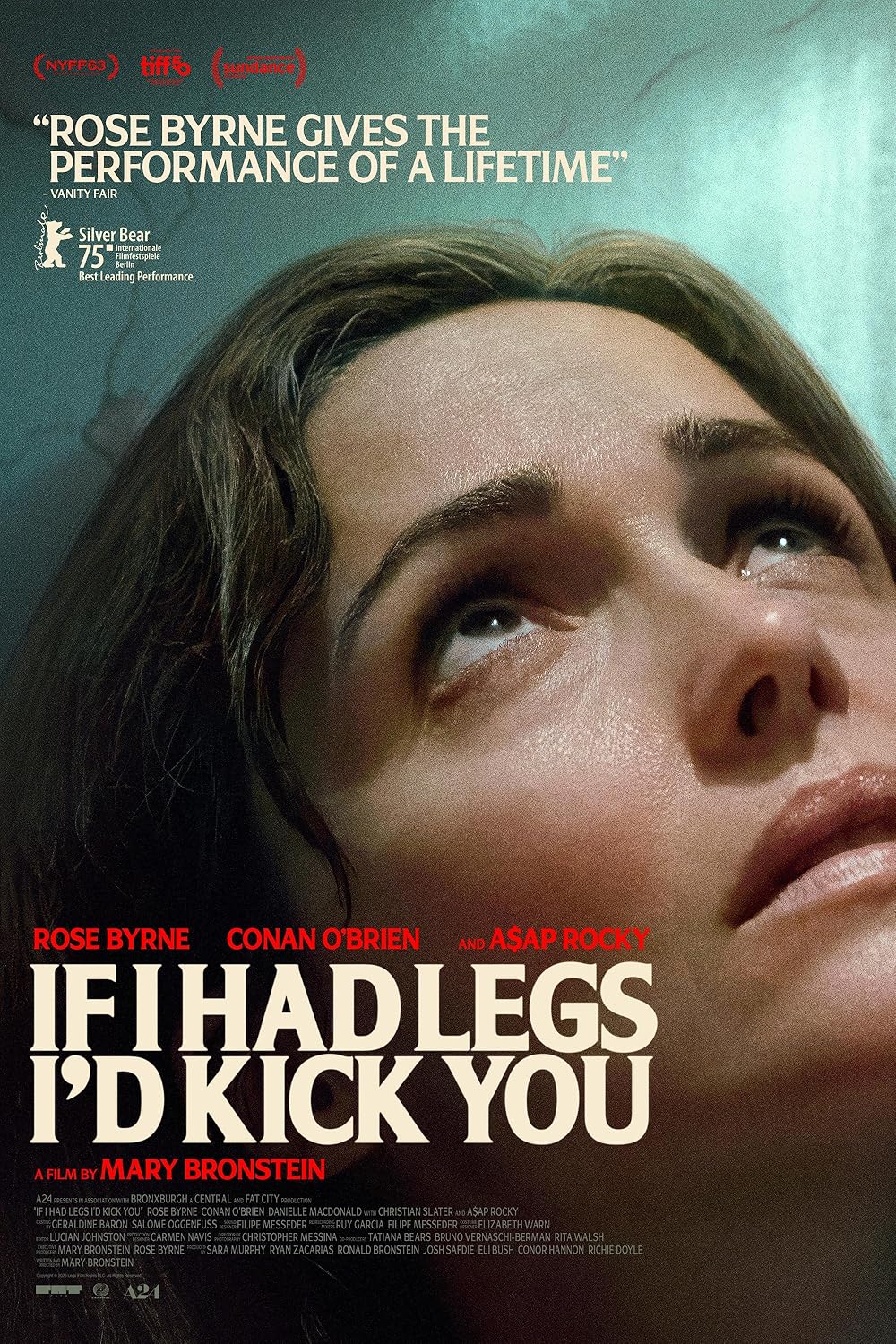
We are thrown into the life of Linda (Byrne), a therapist whose husband is away long-term for work, leaving her alone to care for their sick child, juggling everything from nighttime monitoring and equipment changes to doctor’s appointments and hospital challenges. Linda is already living in a whirlwind of chaos when a huge whole caves in in her apartment, forcing her and her child to move into a motel complete with snotty receptionist and affable neighbour (A$AP Rocky). Compounding her personal strife, Linda is dealing with patients including an anxious new mother (Danielle McDonald) struggling with her baby whose situation escalate just as her own life is crashing down around her. Seeking some kind of refuge in her own therapy sessions with a sardonic and occasionally colleague (Conan O’Brien), Linda is forced to fight through all of the circumstances around her, fulfilling her role as a mother whilst trying not to lose her mind.
From its opening minutes, the film sucks you straight into this whirling nightmare and you are carried along through the chaos right alongside Linda. It is an anxiety-inducing and exhausting fever dream, motherhood as trial by fire (whilst Linda’s situation is specific, the film has a lot to say about the wider experience of motherhood) and features a number of surrealist abstractions that add to the consuming, disorienting ride. Bronstein keeps her, often handheld, camera very tightly framed on Byrne’s face, with the extreme close ups putting us inside her head and helping to enhance the feeling of overstimulation. We are fully in Linda’s point of view and we see nothing she doesn’t see, keeping us spiralling down through the never-ending barrage of challenges she faces (this film is the real One Battle After Another). Bronstein chooses to never show us the child’s face, keeping our sympathies with Linda; we are so immersed in her psyche Bronstein and Byrne keep us on side despite some of her worse decisions as the film is steeped in the desperation that drives them. The film also manages not to villainise the child, reflecting the maternal love that underpins Linda’s actions despite her exasperation. The film too doesn’t disclose the daughter’s specific illness (although the type is alluded to), it isn’t important, all that matters is that the child is ill and in need of extra care.
With both the film’s content and filming style, it needs a powerhouse central performance to do a lot of heavy lifting and Byrne delivers in spades. A career-best performance, she disappears into Linda, communicating a tidal wave of emotion in both small expressions and big outbursts. She is the given nowhere to hide: the camera is trained on her face in extreme close ups for most of the film, her reactions often mattering more than the situations themselves. Whilst she has had ample showcases for her comic gifts, If I Had Legs I’d Kick You gives Byrne the meaty, more dramatic role (with the perfect balance of comedy) that should remind audiences of her versatility and hopefully lead to a variety of exciting future roles. She is supported by a fantastic cast. O’Brien is brilliant as her frequently harsh and unsympathetic therapist, playing against type as a stone wall that Linda’s frazzled energy often fails to breach, whilst still showing enough layers to be believable as a person. A$AP Rocky too impresses in his first acting role as Linda’s motel neighbour whose friendly advances are often rebuked but who finds himself entangled in her life. He imbues the role with a real sense of genuineness. McDonald too is fantastic as the young mother whose own problems are forced into Linda’s life outside of their therapeutic relationship.
The film’s dream logic and abstract moments are woven in throughout the film and very much left up to interpretation. Bronstein also uses repeated imagery, particularly holes and tubes, most obviously emblematic of birth and motherhood. The hole in Linda’s ceiling becomes a character in itself over the course of the film, serving both as metaphor and literal, physical hazard. Whilst these images may not exactly be subtle, they serve their purpose and the abstraction heightens the high-wire emotional feel of the film, dragging us into the corners of Linda’s subconscious, even if we can’t literally understand what is happening there.
In amongst the chaos, the film boasts some comic moments but with the dark overall tone, the comedy is sprinkled in in the way it is in real life. The kinds of moments where if you don’t laugh, you’ll cry or where life has gone so ridiculously off course that yet another thing going wrong goes wrong in the most hilarious way possible. The actors work in moments of humour too in subtle inflections or moments of sarcasm, very seldom are there actual jokes or things happening purely for comedic effect (and when they do you will be watching through your fingers). These are often just moments, barely providing a moment of reprieve from the runaway train that is Linda’s life. The film is perhaps a little too exhausting for its runtime, slightly straining the attention in the second half and may have benefitted from being a little tighter. When we reach the film’s climax, nothing is tied up neatly, clearly the tribulations will continue for the characters even once we are released from their grip, but the film’s final minutes seem to offer something to Linda that, even temporarily, may shift her perspective. Even a brief moment to take half a step back from the situation she was drowning in offers something poignant.
A anxiety-ridden fever dream, this is Byrne at her best and showcases a great collaboration between an actor and director so clearly in sync.


