Arriving on the heels of breathless praise from the North American festivals, I was lucky enough to attend the gala premiere of Hamnet at the London Film Festival. Expectations were high, as was the buzz inside Royal Festival Hall, and the film delivered in full force with its audience left emotionally devastated yet bursting full of life.
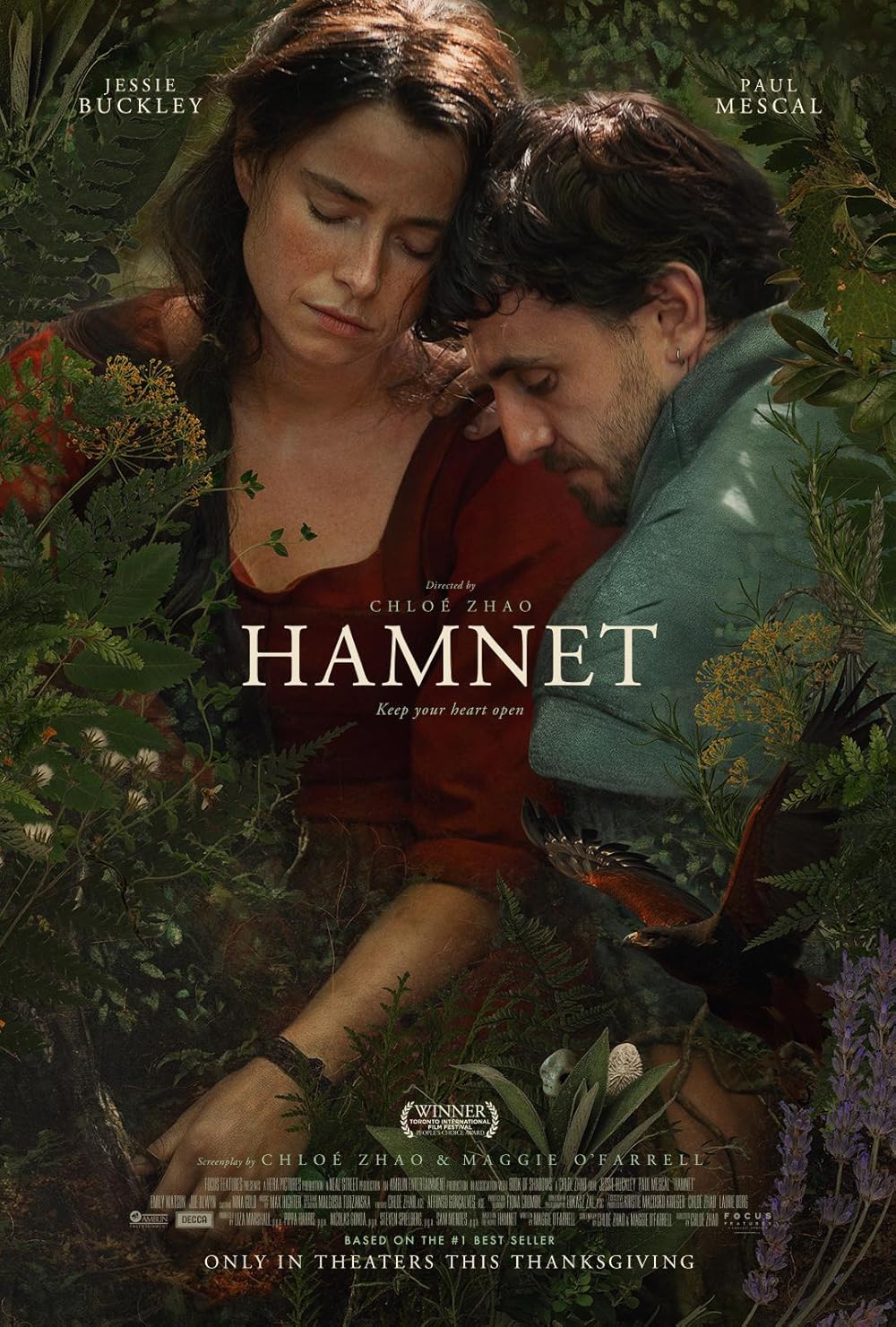
Based on Maggie O’Farrell’s acclaimed novel, Hamnet is a piece of speculative historical fiction focusing on Agnes Hathaway, the wife of William Shakespeare. The film details their courtship – he, a Latin tutor, she, a local outcast due to an almost magical affinity with nature – and the growth of their family. They build a loving home around their three children; the son is named Hamnet – a name used interchangeably at the time with Hamlet. Then the plague comes knocking, and the story descends into a heart-wrenching exploration of grief. Shakespeare may be one of the most famous names in history, and Hamlet one of his most noted works, but this is really the story of a woman and a man, a mother and a father and timeless impact of love and tragedy.
Director Chloé Zhao has crafted a tender and deeply human film, so profoundly empathetic yet never manipulative. The source material marries perfectly with Zhao’s naturalistic yet lyrical style, resulting in a film that feels grounded and spiritual at the same time. Zhao’s sensitivity to the natural world works beautifully in portraying Agnes’ particular relationship with nature, allowing the heartbeat of the Earth to be felt as a character of its own; humming beneath the surface of this story is a meditation on our connection to nature and one another. It is this reminder of our shared humanity, given power by Zhao’s humanistic approach, that imbues the film with its emotionally shattering power. Every nerve is raw and every feeling so deeply felt; the film casts a spell that so enraptures the audience, enveloping them in these characters’ experiences, that by the time the staggering final minutes play out, you are barely able to catch your breath. Grief is a central theme but so is the power of art – the creation of it and, especially, the communal experience of it, how it can become an outlet for pain and how that outlet can be transformative in touching others.
As Agnes, Jessie Buckley gives an all-time performance, one so raw and powerful it leaves an indelible mark. One gut-wrenching moment in particular will be seared into my brain for years to come. Her Agnes is strong but delicate, a commanding presence on screen and undoubtedly the beating heart of the film. She disappears into the part completely and the role is a perfect showcase of all of the subtleties that make her a great actor. She is supported by an excellent Paul Mescal as the mostly unnamed husband who delivers a performance of such fragility and great emotional depth, shedding the icon and instead offering insight into a man’s psyche in his most intimate moments. The ensemble at large is uniformly brilliant – Emily Watson’s bristly exterior masks a maternal compassion, and Jacobi Jupe, as the eponymous Hamnet, delivers one of the most impressive child performances in recent years.
All of this is captured in Łukasz Żal’s exquisite, striking cinematography that gives the landscapes and characters space to breathe but also closes in to create an aching intimacy. Max Richter’s gorgeous score accompanies events, swelling and soaring in harmony with every other part of the film – the piece in the final scene in particular is an absolute standout.
In a lesser team’s hands, the film could have fallen into melodrama, but instead it stands as a rich tapestry of profound emotion. It becomes a portrait of grief, yes, but it also about the commonalities of what makes us human; the emotions we feel, our ties to nature and the way we relate to one another. It will wring out your heart and leave you emotionally wrecked, but also somehow full with the soul nourishment of art and humanity. It may even make you consider your place in things in a different light. A beautiful, devastating and unforgettable experience.


Pingback: ‘Hamnet’, Meditation and the Communal Experience of Art (LFF) | REEL WREN