The latest in the so far largely disappointing new genre of belated sequels hugely bucks the trend. It was a brave move to expand on an iconic classic (whose influence has stretched far and wide across many genres), and it is a risk that absolutely paid off in delivering one of the best sequels we’ve seen, and fully preserving the legacy of the original.
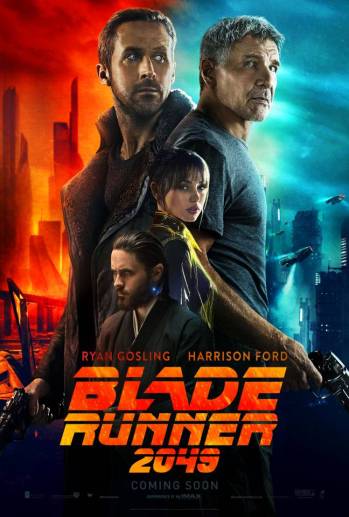 The plot is best kept secret (and judging by the lack of its presence in the trailers, is something the filmmakers wanted), it is one of the films where the less you know, the better. Set 30 years post-Blade Runner, replicants are now being more stably manufactured by the Wallace corporation, but blade runners are still required to hunt down remaining Nexus-6s. In vague terms, the film centres on Officer K (Ryan Gosling), a blade runner who stumbles across a secret that could break down society. As he attempts to uncover more, he seeks out the story behind the revelation, which eventually leads him to Rick Deckard (Harrison Ford). The rest, and any specifics, are better left unsaid to allow you to really go on this journey with K, and be absorbed into the largely subjective nature of the film.
What results is a stunning piece of deeply existential science-fiction that certainly earns the right to stand up next to the original. It is the perfect example of integrating the old with the new to allow it to have come from Blade Runner’s DNA, but be its own entity. Unlike so many sequels, it doesn’t overly rely on nostalgia, using its select references to the past to great effect. These do not only come in name-drops of characters or types of replicants (although these are used well and sparingly), but also in subtler references, such as sequences where the word ‘closer’ emanates the iconic ‘enhance’ of the original; there are numerous nice little touches and Easter eggs that acknowledge the foundation that this film stands on. It skewers the sequel template, becoming something unpredictable, where you are mostly unsure of your own assumptions and guesses.
This feels like a film that was made for and by fans, not by a studio seeking to reboot a classic for purely financial gain (albeit it is sadly not doing the box office business it deserves). It has not succumbed to commerciality, instead clearly being made with care to preserve the original’s legacy. This is essentially a big-budget cult film, an arthouse sci-fi disguised as a blockbuster, and I am thankful for it. It is a slow-burner like the original (so much so that when it picks up by the end, it may even feel slightly rushed), which is part and parcel of its depth – it makes you think, and gives you time to do so. It rewards patience and concentration – something a lot of lesser films nowadays assume all audience lack – and it is true that its pace will prove too slow for some, mostly those less invested. Don’t go in expecting the usual blockbusting action sci-fi of current cinema; the action here is brief and sparse (although when it is done, it is powerful and exciting). It is a relatively long film, taking its time not just in the propulsion of the plot, but in its editing. It lingers on certain frames and scenes much longer than most modern cinema, in a similar vein to the some of the great lengthy films. It allows the viewer time to digest, but keeps them engaged.
It maintains the heady qualities of the first film; the philosophical themes of existence and what it is to be human are prevalent here, and are expanded upon as part of the revelation in the plot. The questions surrounding memories, creation and experience are rife, but are found more in subtext and implications, like the original, than any clunky dialogue. It doesn’t spoon feed you, and it provokes more questions than it answers, keeping you engaged as you, along with K, try to decipher what is going on. It also, crucially and thankfully, maintains the ambiguity of Deckard in terms of human vs replicant, a debate which, if definitively answered, would be an easy way to cheapen and damage the original film. Accompanying the philosophy is an affecting emotional thread that runs throughout the film. To say any more on that would be to spoil it, but all of this is wrapped up in something overall less noir and dark than the original, but that certainly maintains many elements of it.
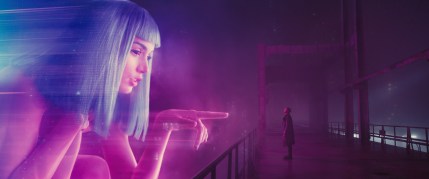
One of the absolutely standout elements of Blade Runner 2049 is its breathtaking visuals. Every single frame is stunning and something to marvel at. If Roger Deakins doesn’t finally get his Oscar for this then faith will be lost. Every scene is bathed in gorgeous lighting and framed in such a spectacular manner you won’t be able to tear your eyes away from the screen. It is at once absorbing and astounding and will leave an embarrassment of images burned into your brain. Captured in this beautiful cinematography is the phenomenal production design that takes elements from the original and runs with them to craft a feat of world building. It maintains a prediction of the future in the vein of the original, but its developments (this film is set 30 years later than the first) feel like an extreme, futuristic version of something we are just on the cusp on. A notable addition is perhaps K’s love interest, Joi, portrayed by Ana de Armas (no specifics, you’ll know when you see it). The film also expands the world geographically – we see beyond the dark and dirty LA to a much different, but still visually striking, environment. The atmosphere that is created by all of this is accompanied by an effective and well-placed soundtrack (by Hans Zimmer and Benjamin Wallfisch) that pays homage to Vangelis’ iconic score, but has the unmistakable influence of Zimmer.
 Director Denis Villeneuve handles the material masterfully (what else have we come to expect from the director). He harnesses the Ridley Scott feel of the original, but never feels like he is imitating it. He takes the legacy and runs with it, taking it further, and using his own vision to add something different. This is another complex and compelling effort from a director who, by now, has certainly cemented himself as one of the greatest working today.
The cast is also fantastic, with the new additions slipping seamlessly into the world, and the old hand of Deckard feeling like much more than a required reprise. Gosling is brilliant as K, keeping you engaged and developing a character with a sense of ambiguity that at one moment can feel like one thing, but in another can cast doubt over that (no specifics for mild spoilers). He is a great protagonist to take over the reigns from Deckard, and fits into the film effortlessly. Deckard himself is still a developing character (too often sequels leave their characters static), overcoming the iconography to feel more real again, and not a mere redo as arguably some of Ford’s other reprises have been received as. Ford himself displays some of his best acting here. His skills are fully utilized to great emotional effect; it’s unlike how we’re used to seeing him, and it is fantastic. When he appears, the film manages not to revert to his perspective, it maintains K’s ownership of the narrative. As for the film’s main villain, Niander Wallace, Jared Leto is good, arguably a bit hammy, but his presence is far scarcer than perhaps expected (which proves to be a good thing). For a film centred on a male protagonist, a lot of the supporting players are populated by strong female characters. As K’s superior in the LAPD, Robin Wright serves up another strong performance as a strong woman, de Armas plays the love interest with much more complexity than they usually are given, and as the main antagonistic presence, Luv, Sylvia Hoeks is much more than your bland henchwoman. The film also comments on women’s role in society, through its allegories and themes of nature.
There are some issues that may be found in the film, be it in Leto’s villain, or the way some exposition is delivered quite heavy handedly by Joi (although it is forgiveable as it arguably fits in with her character), but these are minuscule in comparison with what the film manages to accomplish.
This is what a sequel should be, and more. It has a modern sensibility, but retains the feel of the original; it expands but does not repeat; it asks questions, rather than answering all of the ones we already have. You won’t get up and leave the cinema straight away – you’ll need to sit and contemplate what you have just seen – but it will take much longer to fully absorb, and no doubt further viewings will enrich the experience. This is sure to not just satisfy, but delight fans of the original, but also serves to show us what is really missing in modern cinema.


Pingback: A Guide To: Denis Villeneuve | REEL WREN
Pingback: Beyond 2017 | REEL WREN
Pingback: My Top 10 Films of 2017 | REEL WREN
Pingback: Oscar Nominations 2018: Initial Thoughts | REEL WREN
Pingback: BAFTAs 2018 | REEL WREN
Pingback: Oscars 2018: Predictions and Opinions | REEL WREN