Much fanfare has surrounded Tom Cruise’s return to Capital-A acting having spent the best part of two decades in action hero mode, and a team up with Alejandro G. Iñárritu, a two-time Oscar-winning auteur offered a tantalising promise. The ultimate result is one of the strangest studio offerings in years; it is sure to polarise audiences, if they can figure out what to make of it.
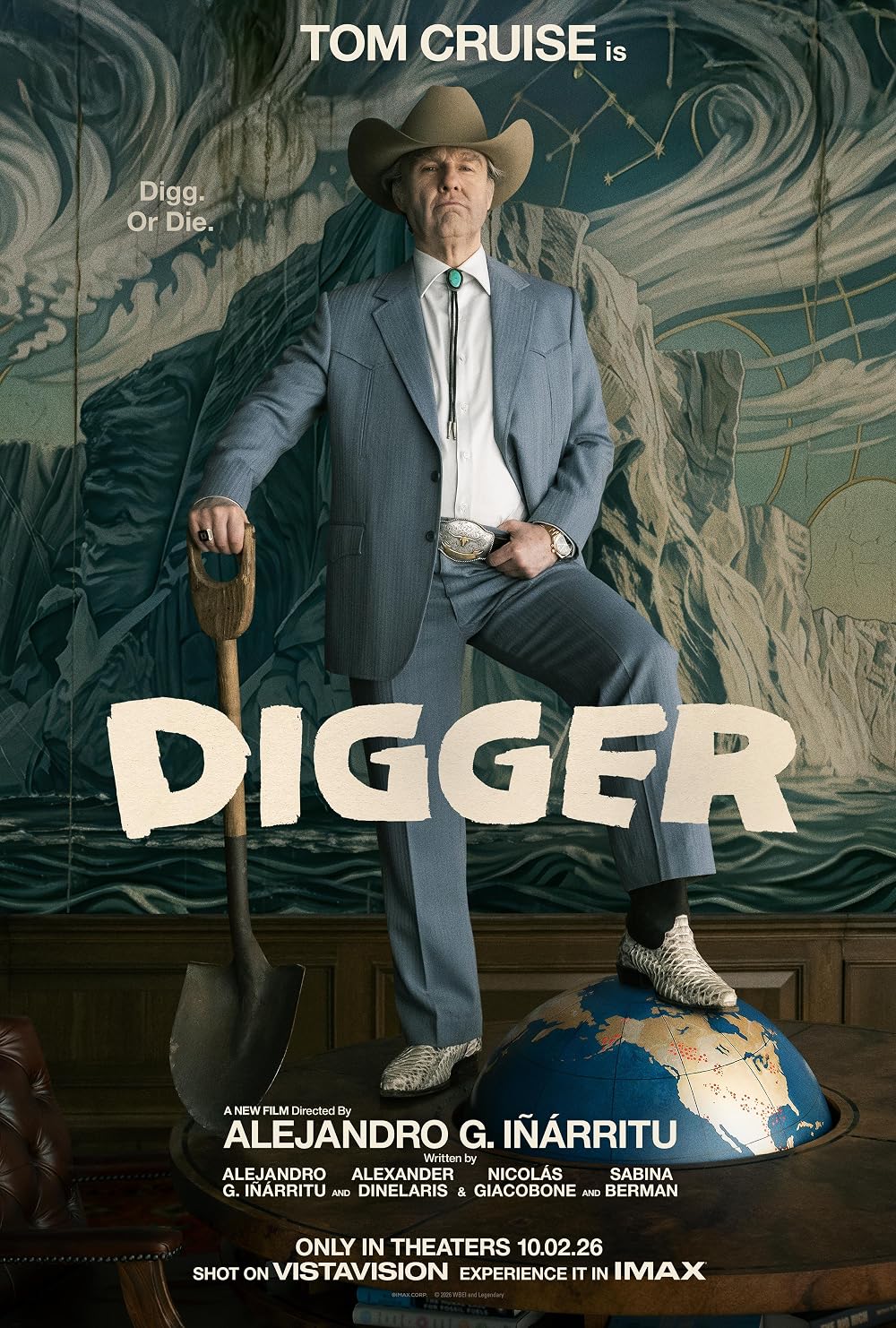
We meet Digger Rockwell (Cruise), an aging Texas oil tycoon whose love for his (freaky) cat seems to take precedence over the larger issues at play. Having declined numerous calls all morning in favour of pouring over the feline, he finds himself on a video call with an employee off the coast of Greenland, frantically trying to warn him that his company’s oil drilling has forced a rapidly expanding crack in the ice with potentially disastrous environmental consequences. Digger dismisses the scientist’s warning in favour of the company’s profit but minutes later receives a visit from his head scientist, Dr. Ganesh (Riz Ahmed), explaining that many of the rig’s crew are dead and a giant ice shelf is hurtling towards Europe. Shirking responsibility, Digger calls a meeting with the US President (John Goodman), complicit in backroom deals to get Digger’s company to drill in the first place, as plans are made to tackle the issue, with money and optics sitting far above lives and the environment.
This is an utterly bizarre film. It is a huge swing of admirable ambition and creativity but it ultimately struggles to connect, throwing of ideas at the wall to see what sticks and leaving the resulting film feeling incoherent and impenetrable. It struggles to build any momentum or energy, leaving sequences feeling flat and empty, and for what is ostensibly described as a satirical black comedy, it is mostly absent of laughs. A few moments connect in their absurdity and some smart jokes land but they are far too few and far between. You are held at an arm’s length, offering little in the way of characterisation for you to know or care about its characters and become invested beyond the clear mirror to the feeling of impending environmental doom that often colours reality. The film constantly leaves you waiting for it to take off but it never totally does. There is a surprise turn not long into the movie (I will not spoil it here), recontextualising the story, but the extra layer fails to add much beyond intrigue at its presence and a subplot that doesn’t lead anywhere. The meta-context of this added layer is also blithely predictable from early on.
The targets of its satire are initially obvious, before later scenes offer an interpretation of a more metatextual target, an interesting angle that is made more obvious in the sound design of the end credits (if you are still engaged enough by that point to notice). It hits the initial targets in obvious ways but doesn’t quite land the metatextual angle although the ideas are interesting. The film becomes too self-aware in another aspect; there are clear scenes that are supposed to be standouts, whether that is with obvious iconic influences (no surprise at moments reminiscent of Dr. Strangelove) or moments meant to play as centrepieces. Again, there is no doubt the ideas behind these are exciting but their execution, or at least place in the larger scheme of the story, doesn’t always work. The film also later shoots itself in the foot in stooping to the point where it has characters literally tell us the film’s messaging, a move so unsubtle that it can no longer be considered satire. It undermines the work of the film so far to clearly communicate that messaging in less obvious terms.
And yet, it remains fascinating (perhaps morbidly so). Whilst the sum of its parts amounts to a frustrating emptiness, the various elements are frequently interesting. It is thrilling to see such bold swings and the film never loses its intrigue; you are never quite sure where it will go next. There are flashes of brilliance and some throwaway lines that really hit the mark, and, regardless of anything else, its visuals are undeniable. The cinematography of Emmanuel Lubezki (operating in a very different way to his previous collaborations with Iñárritu) and production design of Dennis Gassner and Richard L. Johnson are sights to behold, elevating the entire film. The pallid palette at play leans into the film’s nihilistic sense brilliantly. Digger feels like the kind of film that could get reappraised down the line and in the meantime is likely to find a cult following, maybe one that will grow if the film is rewatched.
With an early trailer for the film being a supercut of Cruise’s best roles with a mere 10 second tease of Diggeritself, the film has sold itself on his performance. With help from some terrific makeup work, Cruise is transformed and delivers one of his most interesting performances in years. Digger is brash and arrogant, money-focused to the degree he asks about the state of his oil rig over the lives lost of its crew. Introduced with the presence of his creepy cat (the animatronic is a standout itself), Cruise gives him a level of repulsion but keeps him entirely watchable. It whets the appetite for more interesting roles from Cruise (and the ambition of the film itself makes you hope he’ll throw his weight behind more audacious ideas that otherwise wouldn’t get made).
Elsewhere, the film is populated by a terrific cast, some with too little to do, others utilising their few lines to their greatest capacity. Riz Ahmed is a standout, with a little more characterisation than the others as the good scientist working for the evil corporation, and his expressions offer some of the film’s more lightly comic moments yet he is often the only voice of reason. John Goodman as the president gives a performance of such fantastic expression and vigour, you’re worried he might hurt himself. Plemons (I will not reveal his role) is reliably excellent and Sandra Hüller (as Digger’s sister) and Michael Stuhlbarg (playing the vice president and eking out every ounce of comedy possible) are strong but underutilised.
It is hard to know what to make of the whole affair and a polarisation of opinion is inevitable, but if nothing else it is fantastic to see a film like Digger get made (particularly on this scale). It has big ideas but ultimately feels too empty, serving a cinematic experience of more morbid curiosity than depth or coherent story. There is a lot to think about, but maybe not quite in the way the movie might have hoped. Whatever else is true, it is an experience.


