Playwright-turned-filmmaker Martin McDonaugh’s work is characterised by its pairing of darkly comic sensibilities with crime led drama, and he continues that thread here. Three Billboards is an astonishing film whose story is derived from a tragic event, yet the film manages to be equally laugh-out-loud hilarious, and utterly heartbreaking.
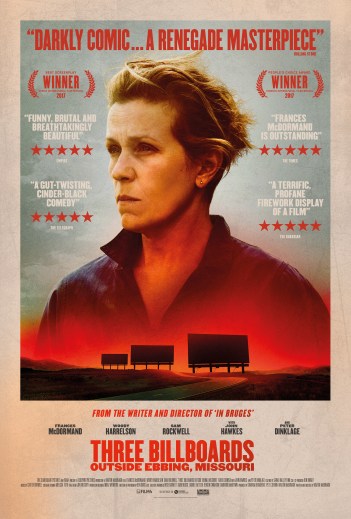 Seven months on from the rape and murder of her teenage daughter, and with no arrests made, Mildred Hayes (Frances McDormand) decides to try and spur on the progress of the town’s police department by renting three billboards, and erecting posters reading ‘raped while dying’, ‘and still no arrests’, ‘how come, Chief Willoughby?’ The chief in question, William Willoughby (Woody Harrelson), is revered and respected within the town, and thus the townspeople do not take kindly to Hayes’ actions, including Willoughby’s fellow members of the police department, most notably Jason Dixon (Sam Rockwell). The ensuing drama, driven by a mother’s guilt and grief, involves verbal and violent battles between various members of the community as exasperation at the lack of police progress grows, as does the antipathy towards Mildred and her billboards.
This is an entirely absorbing work of pure brilliance. The story unfolds into a much more complex saga than you may initially expect. The film blurs the morality of the individuals at play; there is no clear-cut good guy and bad guy. Instead, each character is much more complex as they all seem to operate within a grey area that still allows us to still empathise with them, despite some of their actions. It is not an ‘us vs. them’ situation, and the characters themselves recognise that. They may be spitting venom at each other one moment, but the film peels back the layers and speaks to the humanity of each of them; a humanity that they see in one another. This leads to much more complicated relationships between characters where their feelings and emotions are given space to develop and evolve, and the fronts they perhaps put on are able to be chipped away at in moments. The film fully examines each character from increasing perspectives as the film progresses, allowing us to come to a greater understanding of their motivations and reasoning, preventing them from becoming caricatures or one-note stereotypes.
McDonaugh’s script is very clever and full of witty dialogue. His characters also each have their own defined voice, something amplified by the extraordinary acting. The narrative is unpredictable and never goes quite where you think; McDonaugh is prepared to play with your expectations as well as your presumption of a simplistic moral grounding. The narrative structure also includes only a couple, and sparingly used, flashbacks which are incredibly effective in their scarcity as they keep the focus on the current moment, but allow insight into what Mildred was like prior to her daughter’s death, whilst hinting at a guilt that may accompany her grief. Other devices McDonaugh employs are used so expertly where in a lesser writer-director’s hands, they could have descended into cliché. In particular there are a series of letters read out in voice-over that are incredibly heart-breaking and emotional, and truly add to the atmosphere and story.
McDonaugh’s handle on the film’s tone is masterful – it easily flits between black comedy and shattering moments, without feeling uneven. The comedy is so pitch black at times, you won’t know whether to laugh or you’ll laugh and gasp simultaneously at some of the more shocking moments. Equally, the tragic moments in the film are incredible affecting and elicit deep emotion. This is a tragicomedy in the most balanced sense, but perhaps feels more like a tragedy or drama with a multitude of hilarious moments. The trailer misleads you in this sense, it is far from and out-and-out comedy, and instead is much more intricately layered in a way that both extremes are pulled off expertly. The film also accomplishes the feat of making you really feel as though you have been on a journey with the characters by the end; the mark of a great film, in my opinion.
The film also exhibits some of the best acting of recent years from a truly first class ensemble. Leading the film, and a clear standout, McDormand is phenomenal as Hayes, delivering a transformative and powerhouse performance built upon incredible subtleties that project a huge presence. Her performance is so layered and rich, she is much more than just a grieving mother or revenge seeker, and the complexities of her internal life are beautifully and euthentically shown by McDormand. The other two standouts come from the police officers of Harrelson and Rockwell. Harrelson’s performance is incredible, allowing his character to be thoughtful but harsh when necessary, decidedly human and exhibiting a tender understanding beneath his defence. Rockwell too is revelatory, living and breathing his role and giving him such depth. Each actor fully disappears into their part, and the result is an incredibly affecting authenticity, added to by the way the script helps fully develop their characters. The rest of the cast is filled out by strong turns, helping to fill out the world the film brings us into.
The combined efforts of all involved has resulted in a film that truly feels as though it will become a classic. There are lines and monologues you can see becoming iconic and quotable in years to come, as well as features such as Mildred’s outfit. It is a truly fantastic piece of work, with a brilliant ending, that should be scooping up all of the awards it can.


Pingback: Oscar Nominations 2018: Initial Thoughts | REEL WREN
Pingback: BAFTAs 2018 | REEL WREN
Pingback: Oscars 2018: Predictions and Opinions | REEL WREN
Pingback: The Oscars 2018 | REEL WREN
Pingback: Oscar Noms: A Triumph of the Non-Traditional | REEL WREN