David Lowery returns with a new film leaning towards his darker, arthouse roots that offers up some interesting ideas and memorable visuals but feels too uneven overall to have the desired impact.
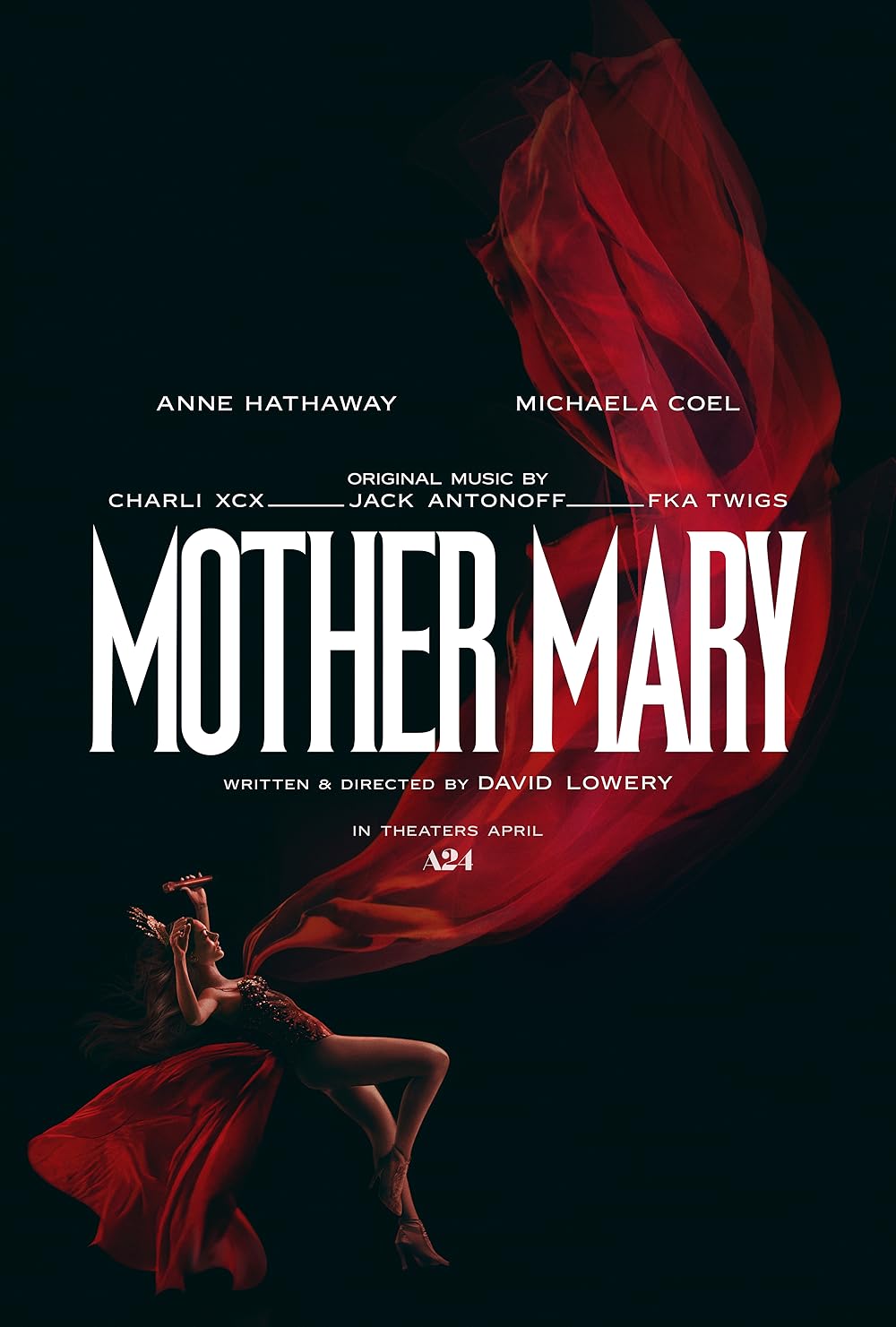
We meet the iconic, larger-than-life pop star, Mother Mary (Anne Hathaway), as she suddenly turns up on the doorstep of her former costume designer, Sam (Michaela Coel), begging for a new dress to be made in a matter of days. She is set for a comeback performance of sorts after an ambiguously sinister event after which she receded from public life and wants something that feels like her, something she believes only Sam can create due to their history. The pair’s breakup was clearly not amicable and Sam is initially unhappy to see her old collaborator before slowly agreeing to reunite. As the pair begin to talk it becomes apparent they have both born witness to something supernatural, albeit through very different experiences.
The film’s initial, lengthy dialogue scenes feel cold and somewhat impenetrable. As the ice between our two leads is picked at, they discuss their past in ambiguous terms but it is hard to really feel their history. This is not a film that gives up the ghost easily but its obtuseness here holds you too much at an arm’s length, casting a veneer that makes it difficult to engage and ultimately causes it to fall a little flat. The dialogue is interesting and unnatural but comes across more as a treatise than conversation. Both within the extended scenes between the pair and the flashbacks intercut, parts also feel a little disparate at the start before the film settles in, however it does successfully create an unsettling atmosphere.
The film spurts to life later as a supernatural element is introduced in the form of a red fabric phantasm, something both women have experienced but in vastly different ways. Here we are treated to dreamlike/nightmarish flashbacks, Sam’s leading with more of her history with Mother Mary’s music post-breakup, and Mother Mary’s with a kind of ghostly summoning conducted by FKA Twig’s character (excellent). There is a clear metaphor in this ghostly entity and the different way the two characters interact with it strikes the contrast in their personalities and approach. Interpretations abound and it is sure to be an interesting discussion point. The film has a lot to say about the creation of art, who it belongs to and when, and who bears the weight of iconography. Artistic drive can be dangerous if not handled in the right way. It also speaks to collaboration and the fracturing of relationships, how that can weigh on a person or be let go of and how only certain people can really reach you or absolve you of some demons.
The more fantastical flashbacks offer some enthralling sequences and striking visuals. Here Lowery’s artistic prowess shines. Whilst they aren’t seamless, they are more engaging and conjure an atmosphere you wish would permeate through the rest of the film. They lead to the film’s climax that does manage somewhat a level of catharsis (in thanks to these sequences), it isn’t quite as powerful as it should be, any emotion connected less to the characters themselves and more the ideas introduced by the metaphor. It doesn’t entirely stick the landing but it is a film you will be unpacking as you leave the cinema.
Coel and Hathaway put in interesting performances and there are occasional shades of Persona (although a much paler iteration). Hathaway’s pop star is vulnerable and clearly in a dark place; unfortunately, the screenplay doesn’t offer much light and shade to make this characterisation more textured (the present-day scenes in general could benefit from a little more variety in tone and tension). She is also entirely believable as a pop star in the film’s myriad concert scenes, with believable songs to boot. Coel’s performance is the more captivating with specific character affectations that round out Sam more and more voice given to her past experience. As much as the metaphors are at play it does feel like the film leaves some cards on the table, hinting at other interesting parts of these characters that it chooses not to explore. This is predominantly a two-hander but a few smaller parts weave in and out, such as Hunter Schafer’s advertised role, but aren’t given enough to make an impact.
The film offers some beautiful visuals and inspired Lowery moments but not quite enough to combat the unevenness. Interesting and unsettling, it has moments that bear further thought, even if the film as a whole doesn’t quite.


