After twenty years and a long build up, the sequel to the cult hit has finally hit screens. Whilst it serves as little more than an addendum to the first, it does have something to say and offers some fun in checking in on beloved characters.
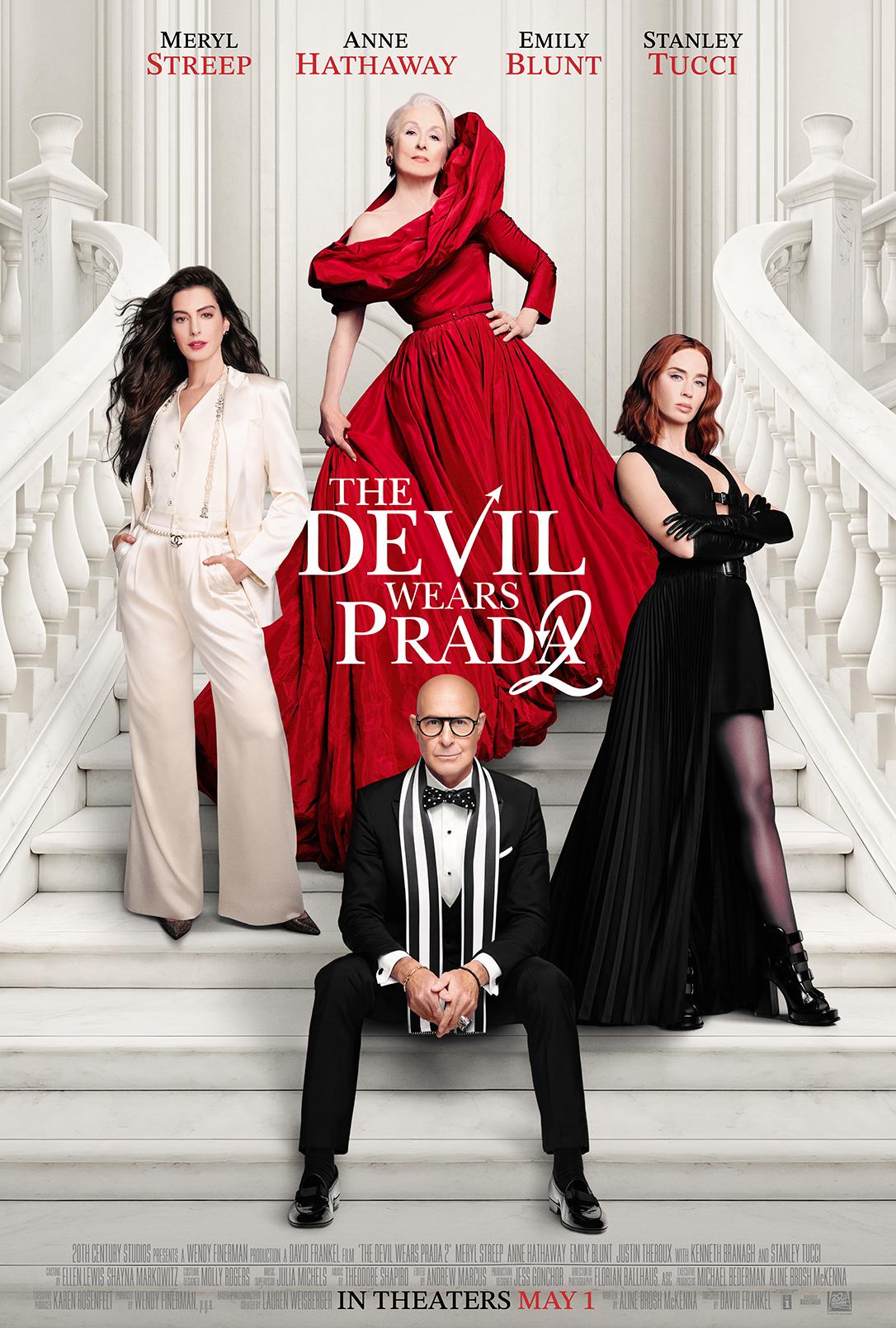
We catch up with Andy Sachs (Anne Hathaway) just as she simultaneously receives an award for her journalistic work and a text informing her that she and her entire team have just been fired. Whilst her indignant acceptance speech railing against the state of modern journalism gains some traction online, Runway finds itself in hot water as a story breaks that the new brand they lavished praise upon uses sweatshops in its manufacturing, sending Miranda Priestly (Meryl Streep) viral for the all the wrong reasons. Andy receives a call from Runway’s big boss Irv Ravitz (Tibor Feldman), offering her the job of Features Editor which she accepts with a touch of reluctance. Soon she is back in the familiar offices, reunited with Nigel (Stanley Tucci) and in amongst a cast of new faces as she is tasked with restoring Runway’s integrity whilst pumping out the kind of click-baity articles that readers won’t scroll past. Far from the shining beacon it once was, Runway has become another casualty of the online world, now overly reliant on advertising to stay afloat. Enter Emily (Emily Blunt), now heading up Dior and whom Miranda must grovel before to maintain a financial relationship. We’re then along for the ride as the characters navigate the modern world and rage against the dying of the medium.
Setting a film at a magazine in 2026 was always going to be markedly different to one set in 2006. The dramatic change in the industry and much more dour state of affairs in the world at large is the backdrop for every beat of the film. As a result, the tone is very different from its predecessor, awash with a melancholia as what was once aspirational and glamorous is now fighting to simply survive. Beyond the reaches of Runway, the film concerns itself with the very real issues facing journalism at large, and a great final shot emphasises that this is one story of many. It is a depressing mirror to society that has significantly dulled The Devil Wears Prada’s sparkle; realistic it may be, escapist entertainment it is not. Whilst it is admirable to see a mainstream film tackle this issue, the central problem that comes from it is a lack of story elsewhere. The film is so concerned with the bigger picture, it gives us little in the form of character development or personal plot to invest in making it less satisfying. Where the first film had the glamorous backdrop, the real story was in a young woman finding her feet and learning to stay true to her principles, despite the world around her. It was about sacrifice and ambition and the toll that takes no matter where you sit on the corporate ladder. Here, the story is only really the decline of industry, with our characters simply scrabbling around to survive.
That is not to say it is without fun. It is undoubtedly a joy to see our leads slip back into character, for the most part almost seamlessly. Whilst now more of a veteran of the industry, Andy remains eager and earnest, if still a tad on the back foot as she is thrust back into the Runway world. She is more confident but you can see her early days come rushing back as she re-enters Miranda’s orbit; Hathaway’s face crumbles into that of her younger self after an initial dressing down by Miranda, hinting at the scars earned from her dog days. It is Andy’s drive that powers the first part of the film with an energetic montage pulling us into her whirlwind and getting us invested in her new mission. There is the odd moment of haphazard physical comedy that feels a little forced for an established 40-something as opposed to the 20-something newbie but for the most part she feels like a matured version of the same character. Blunt slides seamlessly back into the deliciously haughty Emily whose heart is firmly hidden up her sleeve. She is, again, given the best one-liners and delivered brilliantly. Tucci too is still the snide yet kind Nigel, clearly weathered by years at Miranda’s side but playing his cards close to his chest. They each believably have lived the last twenty years but are still recognisable. The biggest change comes in the form of the Devil herself. It is utterly bizarre to see her smiling so much. Clearly, she has lost her throne and her power as the industry has crumbled around her, wearing down her icy demeanour, and clear HR interventions have reduced the level of cruelty she can exhibit in the workplace. Still, it feels as though her edges have become a little too rounded, taking some of the fun out of the character. She is still played by aplomb by Streep but her presence is diminished. This is of course another sign of the times but perhaps taken a step too far and at the expense of dramatic story. Her changing relationship dynamics with Andy feel less believable in this film and at times feel fairly incoherent. A lack of friction takes the spark out of a lot of scenes.
Outside of the core four, the only other returning star is Tracie Thoms as Andy’s best friend who adds a little colour to her personal life and feels like a stable throughline from the first film. Otherwise, new characters bring us into an up-to-date world and the new Runway staff (Simone Ashley, Helen J. Shen and Caleb Hearon in particular) slot right in, each with enough personality to avoid them fading into the background, but few are given much to do. It is particularly bizarre to see Kenneth Branaugh in such a non-role. Andy’s new love interest (Patrick Brammal), while charming is also given so little airtime that the entire subplot feels far too light to matter (paparazzi photos from the set suggest scenes on the cutting room floor). Lucy Liu makes an appearance as a divorcee newly minted as one of the richest women in the world, where Justin Theroux takes the role of her ex-husband, a somewhat cartoonish man who is clearly a satire many real-life figures; those with the money and little else who hold the power. B.J. Novak rounds out the new ensemble as the nepo-baby of the Elias-Clarke chairman, a clear tech-bro wannabe, his real-life counterparts clear targets of the film’s commentary. The film is also stuffed with cameos teetering just this side of excessive; at least they make sense for a film set in this world and it is fun to spot them as they cycle past.
As with any belated sequel, it is full of callbacks although these are mostly done well. There are some direct recreations, but most are less pointed and more subtle (although easily spotted). These offer some fun and the nostalgia also works in the world of the film, both for the Runway of the past and for Andy returning to an old haunt. The film cycles through a number of the same beats as the original, initially without leaning too far into them but ultimately, they do start to feel a little familiar. The original score resurfaces, tinkered with to meet the moment although occasionally it feels incongruent with the dampened tone of a scene. The stakes are industry-wide here where in the first film they were personal so occasionally it doesn’t quite fit. However, it is mostly used effectively and helps to lift the energy of the film.
Due to its subject matter, the film takes itself more seriously and doesn’t have a huge number of laughs. Whilst the original was always a comedy-drama, it still had a slightly frothier feel, whereas here it feels weighed down. It is not as sharp or witty and lacks energy. It moves along at a slightly monotonous pace with little undulation or light and shade in the form of highs and lows. Without the zip of the original it feels a little flat. When Vogue finally and inevitably kicks in it delivers a much-needed jolt (although it is likely no coincidence that this comes at the most glamourous and buzzy moment for the Runway team), although an attempt to mimic the iconic outfit scene of the original fails to recapture the feeling. The slightly more serious tone means that when the film does lean further into melodrama, the moment sticks out; I wasn’t much of a fan of a sudden flipping of one character that temporarily reduces them to a villain of sorts, it didn’t feel natural of fully explicable in terms of character.
As for the fashion, despite the fears brought about by the initial leaked photos, there are only a handful of egregious looks (in my laymen’s opinion) and for the most part the styles suit the characters. Andy has evolved past her lumpy cerulean sweater and ‘hideous’ skirts but isn’t too dressed up, leaning more into tailored takes on menswear. However, few outfits seem primed to remain in the psyche; where the fashion from the original was clearly 2006, it still looks good now, whereas a couple of outfits in this film already feel dated to microtrends from last year. There is also a much more dampened colour palette, a visual language that extends to the rest of the film. Sadly, it does somewhat suffer from the pallid lighting trends of the 2020s, presenting us with a less inviting world, more flat and corporate, but again that is the film’s central conflict (but why should that be inflicted on us).
This is a film more concerned with realism in its set-dressing that a film of its genre usually is. Even as we catch up with the characters they have, refreshingly, faced their own ups and downs, a lack of 100% wish fulfilment maintaining a level of relatability that was key to the first film. It even touches on very prevalent modern issues such as egg freezing and wage stagnation, keeping Andy in line with her peers watching from the cinemas. It is a film for our not-so-feel-good time, but perhaps this is when we need something a little feel-good the most? Social commentary is absolutely vital but its effect on the overall tone makes it feel like an entirely different franchise, but then again, we are living in an entirely different world. It is commendable to take a film like this down this road even if it isn’t entirely successful.
This is not a sequel destined to be forgotten or the kind we collectively put in a drawer and pretend doesn’t exist. Whilst it doesn’t reach the heights of the first film and won’t have the same re-watchability factor, it is an admirable attempt at examining the current moment. There is fun to be had being back with old favourites and it is much better than it could have been. It justifies its existence as a vehicle for social commentary, but doesn’t quite justify its existence as a sequel to its predecessor. Fun, sad but ultimately not entirely memorable.
That’s all.


Pingback: Belated Sequels: Can Nostalgia Survive Reality? | REEL WREN