Hot on the heels of the stratospheric success of Wicked: Part One (it bugs me every time that title card appears since the sequel was renamed For Good), this return to Oz brings us back down with a bump and, once again, highlights the dangers of splitting stories up in the name of money.
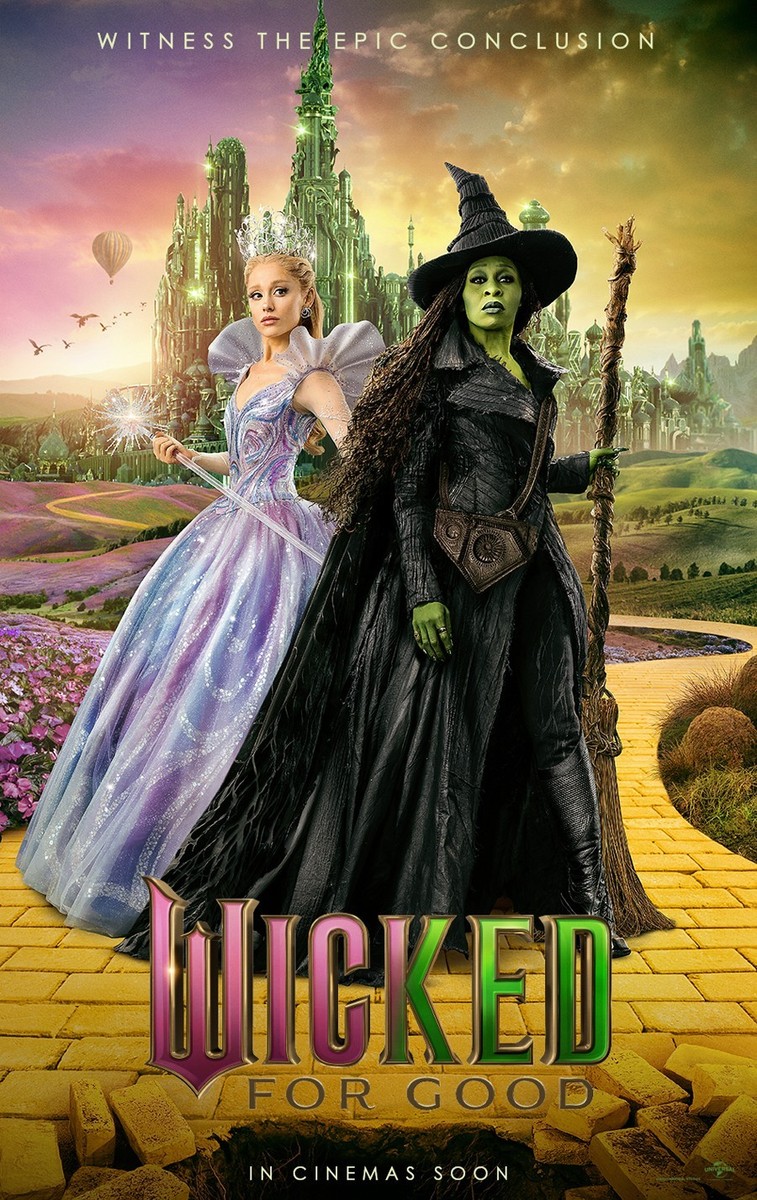
We rejoin Elphaba (Cynthia Erivo) and Glinda (Ariana Grande) a number of years (no one seems sure how many) after the events of the first film. Elphaba is living in exile as the Wicked Witch of the West, still trying to save the animals of Oz and fight the Wizard’s (Jeff Goldblum) power. Glinda, now ordained as Glinda the Good, is a cog in the Wizard’s machine, a figurehead for the laypeople of Oz to boost their spirits and convince them of a good witch to stand off against the bad. Cracks begin to show in Glinda’s façade as the fate of her friend remains ever on her conscience, while Elphaba has not given up on her friend either. Their fates are intertwined and their relationship complicated by politics, power and a love triangle with a certain prince (Jonathan Bailey).
As a fan of the stage show, I was pleasantly surprised with Wicked: Part One and felt they really did the musical justice despite my worries, however, this time, my trepidation at a two-parter seems to have been proven valid; For Good doesn’t quite have the narrative arc to sustain it as a standalone film. Whilst Act 2 of the stage show is generally thought to be weaker, the film had the added runtime to expand on it, make it feel less hurried and develop the plot a little deeper. Instead, the pacing is so off that it somehow feels simultaneously rushed and lagging. It feels bloated and protracted, especially in the beginning (following the opening minutes that do reintroduce you to the world well). The additional time is misused for padding and slowing the plot through unnecessary expanded sequences rather than adding depth to moments or characters to remedy the rushed moments from the show. As a result, the film doesn’t flow and feels disjointed.
The staging of some of the film’s musical numbers also feels weaker than those in the first film. The film doesn’t transition as well into the songs, with some so lacking in build up that they feel too abrupt and unnatural (not what you want from a musical). As Long As You’re Mine stands out as the most bizarrely staged number. The Elphaba-Fiyero subplot would have really benefitted from some of the film’s additional minutes, but instead the song is segued into awkwardly and its blocking really takes away the power of the song. [SPOILER] It is the (only real) moment the two characters are finally together but for half of the song Elphaba is singing alone to herself. The new songs don’t add much to the proceedings. Elphaba’s, at least, centres on an aspect of her character that hasn’t been explicitly explored, but it is ultimately forgettable. Glinda’s comes at a bizarre point in the story, entirely halting its momentum and offering a reckoning that is simply a more obvious rendering of the subtext of Thank Goodness. This as well as an unnecessary reveal flashback later in the film (featuring some poor de-aging) make it feel as though the film has little faith in the audience’s intelligence.
Those unfamiliar with the show will be surprised by the much darker tone of For Good. The second act in the show was always darker, but the first film seemed to have sanded off a lot of the edges that hint at this future. The film is really a commentary on propaganda and fascism, with a lot of important themes at its core. It is rightfully less joyous and more mature than its predecessor. There are still some comedic moments that harken back to Part One but while some work, others are so tonally incongruous it throws you out of the film. One moment in particular comes right after a really serious event (a certain house from Kansas lands on a certain someone) so plays extremely oddly for the characters and doesn’t make sense.
Having said all of this, the film still keeps you invested in its lead characters and the world-building is still a sight to behold. We are transported to Oz thanks to the rich production and costume design and, thanks to the film literally being darker (it is set more at night), there won’t be the same complaints of overexposed, flat lighting. The film communicates its themes effectively and Elphaba and Glinda’s relationship dynamic is still powerful enough to lead to an emotional climax. Much of this is down to the two leads who are still spectacular in their roles. They are able to imbue their characters with a greater depth and maturity that suits their age and the grittier world they now find themselves in. Most of the supporting characters take more of a step back (Fiyero, in particular, feels under-served and could do with greater character development), but the cast deliver performances on par with the first film (although Michelle Yeoh’s singing unfortunately takes you out of the film).
Ultimately, it is serviceable and uneven but maintains an epic feel thanks to the powerhouse performances and strength of the show’s songs. Not changed for the better, but For Good still packs an emotional punch.


Pingback: Singing Standards in Movie Musicals | REEL WREN