The award-winning team behind Juno and Young Adult have returned to give us another intimate glimpse into a time in a woman’s life: motherhood. In Tully, Jason Reitman and Diablo Cody have crafted a tender yet seemingly brutally honest account of the trials and tribulations that come with having small children in a character study that lends itself to the universal.
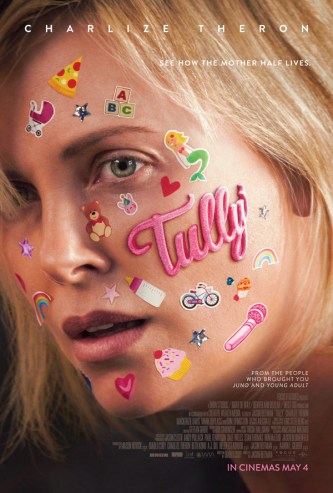 We first meet Marlo (Charlize Theron) towards the end of her third pregnancy (she already has two small children), exhausted and struggling. There are suggestions as to her battle with post-partum depression after having her previous children and, seeing her situation, her wealthier brother (Mark Duplass) announces that his baby gift to her will be to hire a night nanny, to help reduce Marlo’s exhaustion. Initially reluctant, Marlo only takes her brother up on his offer a while after the baby’s birth, and soon arrives Tully (Mackenzie Davis), a carefree young woman who begins to form a close relationship with Marlo, whose life is slowly transformed for the better.
This is a closely observed portrait of the true toll of motherhood. Nothing appears to be sugarcoated; this film does not shy away from the ugly parts of the miracle of life. It feels honest and earnest, developing a sense of authenticity and naturalism from the start that ensures you fully invest in these characters and their lives (whether you can directly relate to the idea of new motherhood or not). It delves into some serious real-life issues that can sometimes come along with the territory, and don’t get discussed enough (even if it doesn’t fully resolve them all in this slice of Marlo’s life we witness). It is a film that feels genuine, an attribute that allocates the film a sizeable amount of power.
After Tully’s introduction, the film shifts gear a little as whilst it continues to show the impacts of motherhood (somewhat reduced by Tully’s input), it also begins to chart the relationship that blossoms between these two women. It is an interesting and uncommon one committed to film and examines the idea of dependency, as well as the effects the different ages and stages of life each person is in can have on their opinions of one another’s problems. It balances itself on the notion that being older does not necessarily make you wiser, nor mean that you have a greater grip or understanding of what you are doing, which leads to some interesting observations. The film does peter off a little in the middle; it remains enjoyable and engaging, and doesn’t lull in pace, but there is less plot development. However, it really picks up again at the film’s climax and later in its conclusion. It becomes unpredictable, and the ending is not what you would expect (although it may feel as though you should have seen it coming). The film that may pop into your head as the closest comparison to Tully leaving the cinema will be one you would never have guessed going in.
What carries the film is the fact that Marlo comes across as such a believable human being. She can laugh and deliver witty one-liners, but also flies into rages and has moments where everything boils over and becomes too much for her. She has immense dimension and depth, in no small part down to Theron’s incredible performance. Armed with a witty, textured and knowing script (and with a director on top form), Theron delivers a tour de force performance, transforming herself into someone who has, believably, barely slept in years, and it just keeping it all together. She elicits great empathy, and it is the evident ability for the film and Theron to bring us inside her mind that allows the film to have the gut-punching effect it does.
This is a film that is hard to categorise. It is very witty and funny, but also delves into some dark territory. The tapestry of emotion that comes together is not incomparable to the nature of real life, and it is in its ability to reflect this that Tully finds its power and greatest strength. It may level off slightly in the middle, but it is more than worth sticking with.


