14 years after the first Hunger Games hit our screens, we’re whisked back to Panem with this second prequel centring on the games of fan-favourite character, Haymitch Abernathy (originally played by Woody Harrelson). Whilst it starts strong and offers some fun in returning to the franchise’s world, it ultimately feels too much like a thin retread of the familiar, landing instead as mostly just another ride on the Hunger Games rollercoaster.

We are taken back 24 years before the events of the first Hunger Games film, to the second quarter quell – the 50th anniversary of the Hunger Games where the anniversary twist is that twice as many tributes will be reaped to enter the games. In District 12 we meet a young Haymitch (Joseph Zada), spending time with his love Lenore Dove (Whitney Peak), before heading out on the morning of his birthday to the annual reaping. The tributes are reaped as we’ve seen before, although how Haymitch’s name comes to be read offers an interesting twist of fate. We follow the journey of the tributes to the Capitol and their initial public appearances prior to the games, although the chariot presentation goes horribly wrong, the result of which gives certain characters a look into a potential revolutionary heart inside Haymitch. He is soon pulled aside by younger iterations of familiar characters and presented with ways to sabotage the games from the inside. By the time we enter the arena, Haymitch’s main concern is to carry out these secret plans in an attempt to begin an overthrow of the Capitol’s power.
Sunrise on the Reaping is sporadically engaging enough across its runtime to mostly maintain your attention but it lacks depth of character and is far too pointed in its familiar themes to feel much more than a flimsy add-on to a successful franchise. It is an improvement on The Ballad of Songbirds and Snakes but leans too heavily on the original films to stand up in its own right. It is strongest at the beginning; the initial scenes in District 12 are immediately absorbing as they bring us back into the world that we already have that strong connection to. Despite the familiarity of the reaping, the horror of it remains potent and the way it plays out brings fresh intrigue and tension. We also get a little more insight into the mechanisms of the TV propaganda, as Plutarch Heavensbee (Jesse Plemons) comes more into the fray. As we follow the new tributes on the familiar journey to the Capitol, differing character dynamics, such as Haymitch playing the protector to young tribute Louella (Molly McCann), and the standout strong-willed defiance of Maysilee Donner (McKenna Grace) stop the familiar from feeling repetitive. There is also interest to be found in the production design of a new era Panem, one that seems to pull a little more from 70s style, and injects more colour. Much of the pre-games fare at the Capitol rides on the curiosity and intrigue of seeing younger versions of characters we’ve seen in the Katniss era, although the events of the chariot presentation inject fresh drama, even if the horror isn’t felt quite as viscerally as it should be, slightly putting us on the backfoot and shaking up the predictability.

As Haymitch is then singled out as a potential ally to underground rebellious rumblings, there is intrigue as he is pulled aside but it also feels a little too much like he is ‘the chosen one’, as opposed to an opportunity. Of course, the likes of Plutarch would present matters in such a manner in order to convince Haymitch but the film’s treatment of it rings a little hollow and a touch more manufactured than Katniss’ rise in the later films. By the time we enter the games themselves, we are pulled too far into Haymitch’s ‘man-on-a-mission’ plotline that it at times it feels like it forgets that there is a forced fight to the death going on all around. Much of the games segment of the film feels like an anti-climax, there are fewer set pieces and the suspense wavers. We often don’t feel the fear in the way we should, and when we do reach fight sequences or confrontations they are tense and spike the energy, but feel too isolated; their impact and threat should permeate the entire experience in the arena. The arena itself is also more colourful; the cornucopia area feels very Midsommar-esque. There are new weapons wielded in fresh ways, with one moment in particular showing exciting invention. We also get perhaps the first iteration of Chekhov’s bicycle bell? There are some new interesting and scary flora and fauna conjured up by the Capitol, although, again, their threat is felt too sporadically. There are also some very strange choices that, again, dilute the feeling of danger and urgency, such as having two allied characters sit on an elevated rock in plain view to stitch up their wounds and talk; a sweeping vista apparently more important than staying hidden from those out for their blood. The entire sequence feels too short and somewhat too easy.
There is some fun and tension to be had but it ultimately lacks suspense and suffers from a lack of deep emotional investment in the majority of its characters. The film forgets the quiet moments to really develop the characters and their relationships. Its concern with keeping the plot moving is perhaps a good thing due to its extended run time (it could be leaner in some respects), but it means that emotional moments don’t hit as hard as we don’t get to know these characters that well. Haymitch himself feels a little bland at times, a pawn in the plot more than a character in his own right. He was never going to be like the Haymitch we’ve known as as an adult – clearly the events of this film would be what drove him to the drink and ground down his view of the world – but he feels a little too cookie-cutter hero at times. Again, a likely result of skipping quieter moments and throwing him straight through the plot.
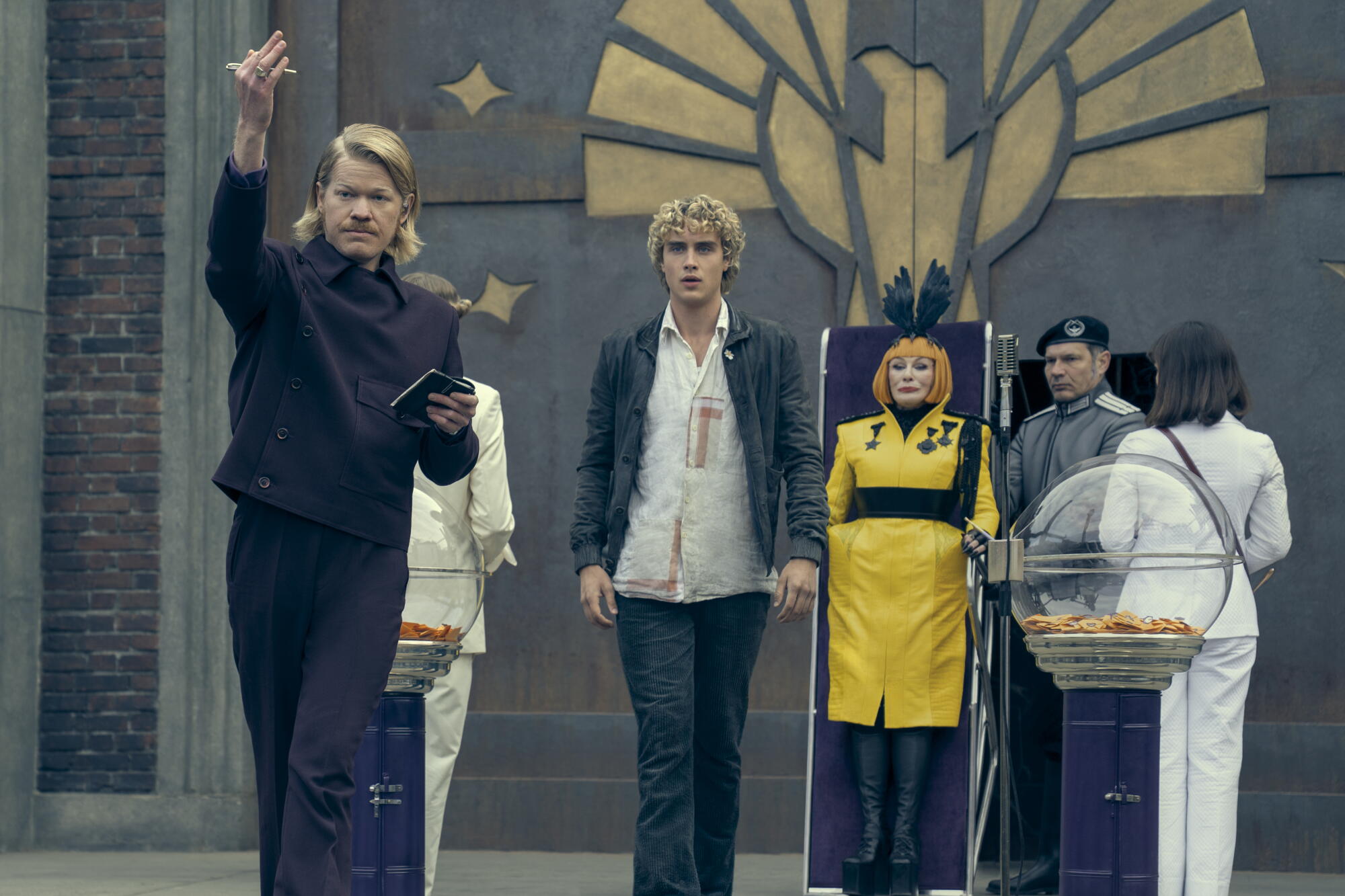
Zada does a great job of carrying the film; in spite of the above, you are still on the character’s side and rooting for him. Grace is the standout with her prickly Maysilee whose depth is felt even if she only gently reveals it at choice moments. Ben Wang is likeable as the fourth tribute from District 12, rounding out the team. Elsewhere, the majority of the tributes are nameless (there are 48 of them after all), and the select pair set up as the main ‘careers’ (from the districts that train their children to win as a matter of honour and bloodlust) – played by Panache Barker and Laura Marcus – are menacing enough to build the required tension. Of the younger versions of older characters, Elle Fanning is the standout as Effie Trinket; you have no doubts that this young woman grow up to become Elizabeth Banks’ version. Kieran Culkin is also fun as Caesar Flickerman, although slightly lacking the believably faux-sincerity of Stanley Tucci’s iteration. Plemons is terrific as Heavensbee, sliding into the Philip Seymour Hoffman role without leaning to heavily on it. Ralph Fiennes as President Snow is clearly tasked with linking the young version (played by Tom Blyth in the last film) and Donald Sutherland’s ultimate portrayal. He has more of a sullenness and a slight tortured look behind the eyes; he is still cold and calculated but less expressly evil than his older self. Of the adult newcomers, Glenn Close is brilliantly horrible, clearly relishing the theatrics of her role and earning much fun despise from the audience (her entrance called to mind Hannibal Lector in a perhaps unintentionally hilarious detail).
The film retains the rebellious spirit that has always been the heart of the franchise and its messaging, and part of why it has resonated so deeply with people. The issue here is that it becomes too pointed in spelling out these themes which feels incredibly unnecessary for the sixth film in the series and weighs it down more than organically integrating it with the story. Much of what is discussed is the idea that nothing is inevitable, that you do not need to accept the Capitol as something preordained and inescapable, that you must have the hope to imagine a different future. It is a noble and important message but becomes somewhat belaboured by the repetition of ‘inevitable’ in dialogue. The fact is everything here feels totally inevitable, part of the baggage that comes with being a prequel. We know the essential parts of how everything ends up for these characters, and even within that there are other turns of predictability. It doesn’t help build any suspense and means, at times, the film feels like its going through the motions. There are also some very pointed references to future events that add to this feeling and characters speak in platitudes too often, making them feel purely like vessels for the message than people in their own right.
The film’s flaws are propped up by the work of the previous films and ultimately, it is that original power that allow it to tie itself up in a satisfactory way in its finale, bringing more weight to the film’s events in retrospect. Of course, this is where the original stars Jennifer Lawrence, Josh Hutcherson and Woody Harrelson come into play in their much-teased returns to their roles. It is a cheap trick, done cheesily and briefly, but it absolutely worked on me. Seeing the old gang is incredibly effective and it wraps the film up well, reiterating that the character we have just followed is in fact one already beloved by us, the audience. It ties the stories together in a way that feels like a good capstone to the entire affair. Should more films be churned out, it feels like it will be at a real risk of diluting the original legacy.
An interesting return to Panem that leans too heavily on the original films to really stand on its own two feet. It lacks enough depth to be truly memorable but is a diverting ride, maintaining the spirit of the original stories, even if it delivers them heavy-handedly.


