John Carney returns with another music-lead charmer, bringing more sincerity and hope to our screens.
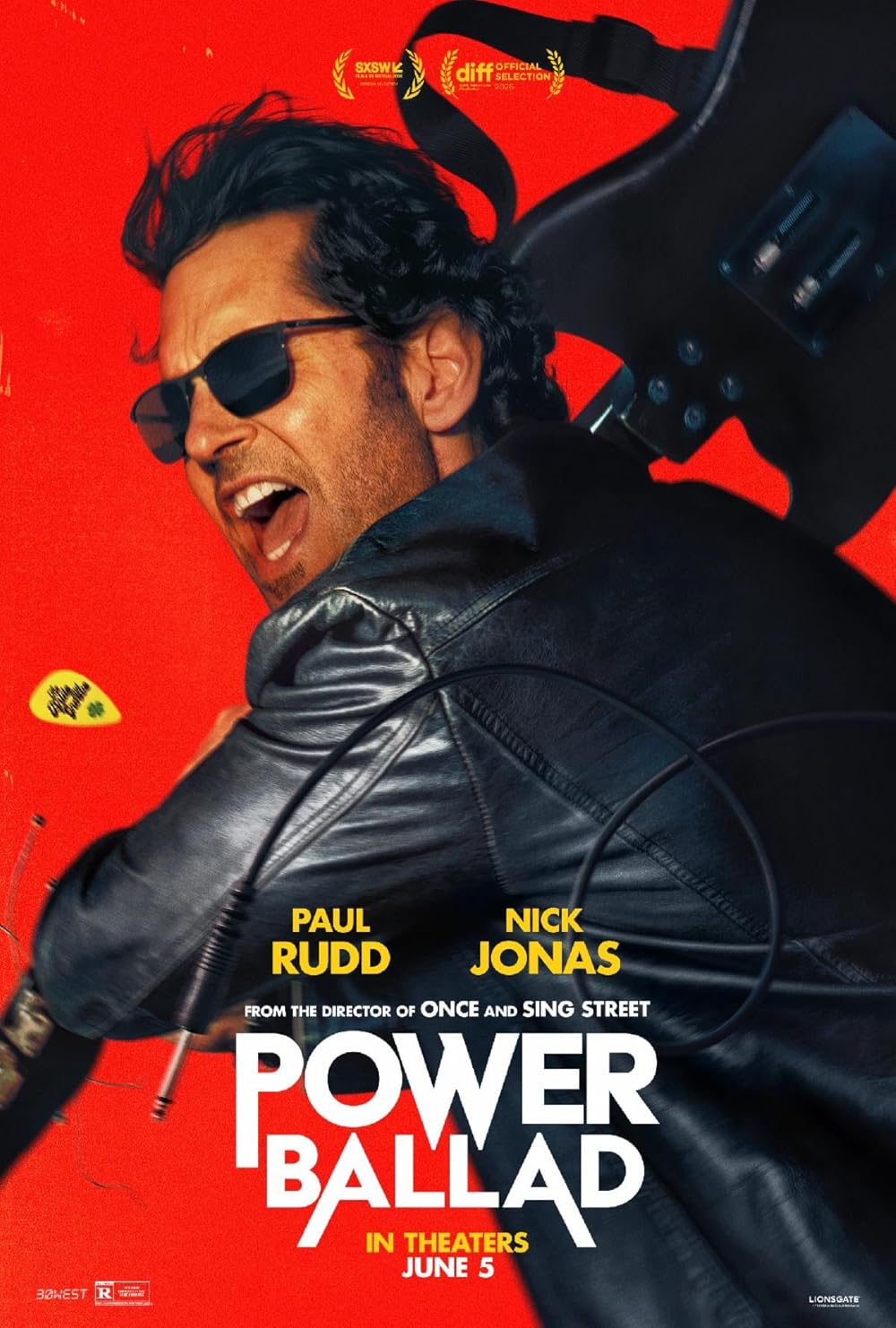
We follow Rick Power (Paul Rudd) – yes, the title is apparently a pun – the American lead singer of a wedding band in Ireland who seems somewhat content with his life but still harbours dreams of stardom that haven’t come to fruition. At one wedding, friend of the couple and ex-boyband member, Danny Wilson (Nick Jonas), is pulled up onstage alongside Rick. Their instant chemistry later leads to a night of songwriting, with each musician sharing their works-in-progress before going their separate ways. Months later, Danny releases his post-boyband debut single How to Write a Song (Without You), one of Rick’s creations that becomes a global hit, sending Rick into a spiral that forces him on a journey to try and get the credit he deserves.
Power Ballad carries the charming, gentle spirit of Carney’s other films, and the full-blooded belief in the power of music that has little place for cynicism. It has a few more darker notes than his past few features, but the tone is balanced well; the drama and lightness don’t feel out of kilter. It explores artists’ relationships to their art a little deeper, posing questions of whether the creation itself matters more than the credit and if an audience’s reception can be gratifying, no matter how big that audience is. It touches on the sanctity of sharing art and the betrayal when that trust is breached. It also digs into unrealised dreams, how our visions of our life evolve and how getting a taste of something you’ve always wanted can change how you think about what you already have.
The film hinges on the initial chemistry of its leads, despite them sharing only a handful of scenes. As soon as Rudd and Jonas are thrown together you can feel a sense of kindred spirits and the chemistry is so instantaneous that it makes their open sharing of their music completely believable. Their platonic night together, with a few adjustments, wouldn’t look out of place in a romance. Their difference in ages is referenced in a few jokes but it wisely avoids becoming a cliched generational conflict. The humanity of Carney’s gaze also keeps treats both characters equally; fame or commercial success doesn’t factor into status. Both actors deliver great performances, with Rudd revealing gristly layers whilst maintaining sympathy, and Jonas humanising the figure of global pop star (although he could be given a little more to do). Later, when the two become somewhat adversaries, neither Rick nor Danny are reduced to caricatures. Danny’s actions are vilified, certainly, in Rick’s mind, but the man himself isn’t portrayed as some selfish fame-hungry villain, but another person muddling through, caught up in the demands of his dreams. Rick too doesn’t become purely vindictive and is allowed depths, driven by the pain of unfulfilled dreams. When the two men come face to face, it is artist to artist and human to human, not David against Goliath. The film wisely avoids a contrived showdown and instead offers something more nuanced.
The song itself is a semi-believable cheesy pop song but doesn’t quite reach the heights that make it entirely realistic, especially in our cynical age (the song’s ‘old school’ sound is referenced in the film – a clear product of the leads’ age differences – and it certainly belongs more to the optimism of yesteryear). In thinking about this song in the context of Carney’s oeuvre, I actually ending up with Lost Stars from Begin Again stuck in my head instead. The worldwide pop smash scenes also don’t quite ring true, making it a struggle to fully buy into the world. There is also some out of sync lip syncing that is a little distracting but forgivable. Elsewhere, the needle drops bring classic after classic; you would expect nothing less.
Whilst it may feel a little slight and could have been longer, the film ultimately winds up at a very satisfying ending, communicating everything we need to know without dragging us through predictable scenes. There is even a fun little Once reference. It is a contained story, despite its larger stage, and it might feel just a little too neat. Then again, perhaps we’re just not as used to films that want to tell us a story without cynicism anymore.
An enjoyable addition to the music-movie genre, Power Ballad offers a levity grounded in real emotion. Plus, it’s great to see Rudd back in this kind of film.


