Reuniting with his Worst Person in the World star, Renate Reinsve, Joachim Trier returns with a delicate yet raw portrait of family dynamics that serves as a reminder than within each family unit, every individual is also a world unto themselves.
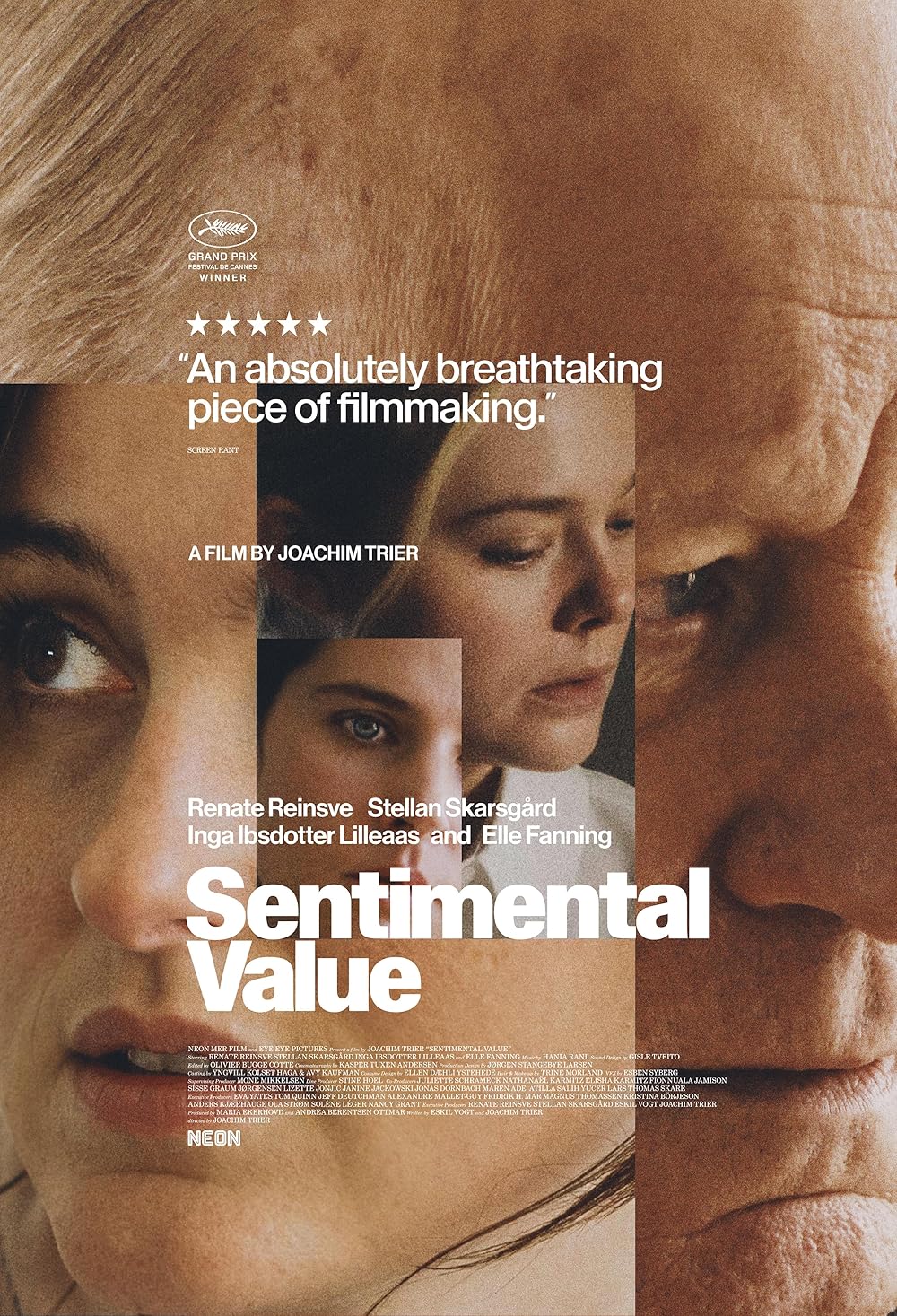
We meet Nora (Renate Reinsve), an actress, and her sister, Agnes (Inga Ibsdotter Lilleaas), as their estranged father, Gustav (Stellan Skarsgård), re-enters their lives. A renowned filmmaker in his heyday, now navigating the current film climate and streaming age, Gustav has written a new film, based on the life of his mother, part of the WWII resistance who suffered torture and ultimately took her own life, and offers Nora the part. Owing to their complex relationship, Nora turns it down, yet cannot escape Gustav as he plans to shoot the film in their generational family home and brings in a famous American actress (Elle Fanning) to take over the role. The family are forced to confront their complicated dynamics and navigate their presence in and impact on one another’s lives, all with the stranger movie star wandering around in the middle of it.
What follows is an intricate portrait of familial relations and how their expression in and the act of art can both complicate and encourage a healing. It is deeply involving and feels entirely authentic. In lesser hands, the film’s basic plot could descend into melodrama, with the strained relationships being one note and emotional breakthroughs coming in forced climaxes. Instead, under Trier’s masterful direction and with a beautiful script and breathtaking performances, Sentimental Value is a masterclass in nuance and humanity. Relationships ebb and flow, even if they are more heavily defined by an overarching emotion. Characters change as much due to their own issues and trauma than those directly caused by another person, although these are intricately interlinked and there is a lot of a illusion to generational trauma and the impact of childhood experience, even how that differs for two siblings raised in the same circumstances. Emotions swell and revelations come but they are handled so delicately that they feel entirely real and believable. We are entirely absorbed into these characters’ lives, living and breathing every subtle inflection and curious turning of a corner. Authenticity is at the heart of the film’s power, where even characters from the Hollywood world within the film are offered the same level of understanding as individual human beings.
As masterfully crafted as Sentimental Value is (all aspects of the filmmaking work in perfect harmony, from the flowing, clever cinematography that is imbued with emotion to the beautifully rendered screenplay), this is a film that lives or dies on its performances, and Sentimental Value boasts some of the best performances of the year and one of the strongest ensembles in a long time. Reinsve further asserts herself as one of the most extraordinary actresses of her generation; her character contains multitudes that she allows to peek or pour out throughout the film, whether in big shows of emotion of the flicker of her eyes. She is matched by Ibsdotter Lilleaas, an emotional foil, more settled in her own life than Nora but still deeply affected by her sister’s strife and managing her own feelings of her father’s return. Together they create an incredible chemistry and a sisterly bond that carries the gravity of lifelong history and the brevity that comes from knowing someone else so completely. Skarsgård is at the top of his game, giving a performance full of subtleties that invites you in to question his character and his motives. There is a push and pull within him and a deep internal life. Fanning is also excellent in a role that too is rounded given depth and not relegated to some kind of inserted villain of the piece; she is simply a part of this moving puzzle and treated as such by the other characters. Every actor also perfectly plays the kind of code-switching that happens with different family members, depending on your relationship, whether in more obvious forms or a slight adjustment of body language. Between them, the ensemble weaves a complicated thread and the film tracks the subtle movements in relationships as the story unfolds.
The film-within-a-film element adds another layer to the proceedings that plays out beautifully. A device that could be heavy-handed or manipulative is instead here an intriguing exploration of art, particularly art leaning towards roman à clef, and the complexities of dealing with real emotions in fictionalised forms. It also explores how the act of making art itself holds immense power and how collaborators can change the ultimate form of a piece. How can relationships and familiar knowledge affect interpretation and if art is intended for one person, can it ever work if their role is fulfilled by someone else? There is also the reflection of family history in Gustav’s film, the impacts of language and culture, and the feeling of personal stories being opened up to the world, with or without consent of all those attached. Gustav’s story may be, ostensibly, about his mother, but all generations of his family are tied up in it as, intentionally or not, his relationship issues are worked out on the page. Trier offers a lot of food for thought and utilises this part of the film to full effect, using it to tease out the tension between our characters and as something to potentially draw them closer. It is masterful.
An absorbing, adult family drama, Sentimental Value is an exquisite showcase for all involved and leaves you wondering of the ongoings inside that red house long after the credits roll.


