Another genre that has become a rare species – the western – is revived here in a fairly traditional manner, but with themes that are still sadly quite relevant today, over 100 years after when the film is set.
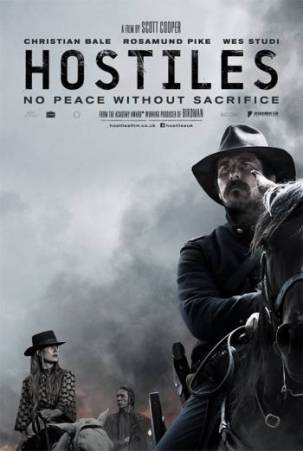 Set in 1892, at the height of the ‘Indian Wars’, where brutality between the Native Americans and those whose armies now patrol the land was at fever pitch, the film chronicles a journeying group consisting of the mix of races. A nearly-retired Army Captain, Joe Blocker (Christian Bale), is charged with taking a dying Cheyenne war chief (Wes Studi) and his family back to their homeland (having been held in captivity by the army), for him to die in peace. Blocker, a hater of the Indian people, and someone who has a personal vendetta against the chief, reluctantly agrees to do so (essentially via blackmail), but immediately reverts the Native Americans back to prisoner status as soon as he is far enough away from command. Along the way, they pick up Rosalie Quaid (Rosamund Pike), a woman whose entire family is viciously slaughtered in the film’s incredibly violent opening. As they travel, and come under attack from common enemies, their experiences begin to break down the racism and prejudice, and the relationships within the group change.
The film’s meditation on prejudice is introduced from the outset where the first two scenes are alternately show brutal violence by Native Americans on a settler family, and then vice versa. This paints the film as having no alliance to one side, but instead being an examination of the human brutality that has been evidenced in all. It is an interesting introduction, whose themes weigh heavily upon the film’s events.
The film feels as though it grows organically, nothing feels forced for the dramatics, and each incident resonates in the following events – this is not a film that does things for effect in the moment, and then seemingly forgets they have occurred later on. We see the toll the experiences take on the characters; Rosalie’s grief is not over and done with in a short amount of time, the murders and the loss of men is not skimmed over as irrelevant, the characters grow and evolve through their experiences, as do their relationships. This leads to some very tender, emotional moments, earned by the character development and build up, and executed through the film’s mostly excellent awareness of characters’ humanity. It also leads to a rarely seen, but well woven in depiction of PTSD, which comes into play in ways varying from subtle to fatal.
The film rests on a tremendous performance from Bale. As the strong, stoic captain, he manages to maintain the outer front his character needs to put on, but in small ways displays the build up of emotion underneath that occasionally leaks out. He carries you through the film. Around him, Pike is very good as the grieving Quaid, and the film makes sure she is much more than a damsel in distress (most of the time). She is a character with her own agency and capabilities, she doesn’t bend to the will of the men, and neither is she forced into an inappropriate romantic situation. She maintains her grief, but grows in how she deals with it, eliciting some powerfully emotional moments. Studi is also excellent as the chief, he is quiet yet dictates a powerful presence so he is always felt. The rest of the ensemble fill out the world terrifically, breathing life into characters so they, for the most part, feel like people, not just disposable accessories ready to be added to the body count. The deaths that occur, are felt.
The film is a slow-burner, but due to unevenness in the story, it dips into disengaging at times. Some of the conversations are a little tedious, and it feels as though it is a little overlong to fully sustain your attention.
Overall, it is a thoughtful (and relevant) take on a Western that contains more tenderness than you might expect. It is carried through lulls on the strength of its central performances, and the stunningly composed frames and striking visuals that make this a beauty to behold, even when the story isn’t quite gripping you.


