*This is a modified repost of my LFF review*
The latest from Little Miss Sunshine directors Jonathan Dayton and Valerie Faris, tells the true story of the 1973 tennis match between Billie Jean King and Bobby Riggs, and elevates itself from the kind of sports movie it could have been, through its exploration of the people behind the game and their journeys to it.
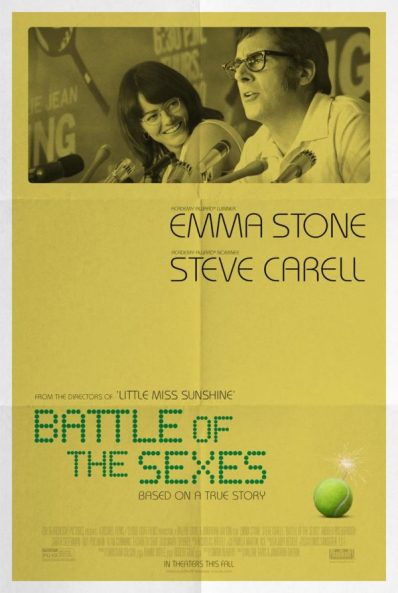 The film follows Billie Jean King (Emma Stone) from her US Open victory, after which she learned that the women’s prize money for their next tournament was to be eight times less than the men’s. Outraged, she and a group of the top female tennis players staged a boycott of the LTA tournaments, electing to set up their own, in founding the Women’s Tennis Association. Subsequently, the women, along with Gladys Heldman (founder of the World Tennis Magazine, played by Sarah Silverman), formed the Virginia Slims Tour, to prove their point that women’s tennis was just as exciting and watched as men’s, and should be treated with equal respect (both socially and financially). Having become a frontwoman for the female tennis players’ battle for equality, as well as being the number one female tennis player, King is approached by ex-men’s tennis player Bobby Riggs (Steve Carrell) the self-styled ‘male chauvinist pig’, and challenged to a tennis match. After a series of events, the challenge is accepted, and what was initially a tennis match designed to potentially inflate an old, sexist tennis player’s ego, becomes so much more.
The film does dive in a little quickly, but manages to pull you in with it. It then follows the personal build-ups of the two tennis adversaries (although seems to show more of King), allowing us to see behind the match and public game-talk, to understand the people more, and their real motivations for taking part in the match.
On King’s side, she is not only embroiled in a fight for equality, but is also facing a much more personal, and private, battle with coming to terms with her own sexuality. Admist the tennis bravado, a tender romance blossoms between her and hairdresser Marilyn Barnett (Andrea Riseborough), despite King being married. This forms the central personal conflict for King, as she not only has to deal with coming to terms with her sexuality, but also carries concern for how this, and her actions, may affect those around her. Then there is the public struggle for equality, all whilst keeping the career-threatening personal struggle completely private. This paints a much more complex picture of King, showing her as a real person, not merely a symbol.
On Riggs’ side, we get glimpses behind the show the ‘chauvinist pig’, seeing his family life, as well as the other reason he proposed the tennis match. It was not solely to gloat about his perceived male superiority, but a way for him to get back in the game, to relive his glory days that he seems to crave (as well as providing a gambler with a high stakes bet). It also suggests that at least a little part of his sexist persona was for show, and even manages to elicit some sense of sympathy for him at certain points (in amongst the moments of outrage of disgust).
These two people are brought to life by great central performances. Stone is entirely believable as the tennis player, imbuing King with the drive she so clearly had, but also portraying her vulnerabilities, and humanizing the icon. Carell, too, brings more depth to a role that could otherwise have just been played as a caricature, instead letting us peek at the private side to Riggs, and understand him more as a person. They are supported by a great cast, with Bill Pullman as the sneering Jack Kramer, Silverman as the sharp Heldman, and Riseborough as the gentle love interest as the standouts.
The film succeeds in highlighting the big issues of inequality, but also the smaller scale sexism that is still, unfortunately, fairly rampant today. This can be in the way the waitress in constantly addressed as ‘honey’ by the men, or the way the male commentator puts his arm around his female counterpart in a domineering manner. Perhaps the frame this film puts them in, will help more people to notice the issue with them, and change the way they approach certain situations in real life.
The final tennis match itself isn’t as exciting as it could be. Any tension or pay off reply mostly on the build up, but this is strong enough that it still ensures goosebump moments, and a great sense of triumph, both when the players enter the stadium (with much grandeur), and in the crowning moment.
It is a powerfully feminist film, invoking anger at injustice, and inspiration from those who fought against it. Sadly, reality will bring you down a little after the credits roll as you realise that this is far too relevant, and timely, all these decades later.


Pingback: DVDs of the Month: March | REEL WREN